Scroll to the end of the article to hear the song.
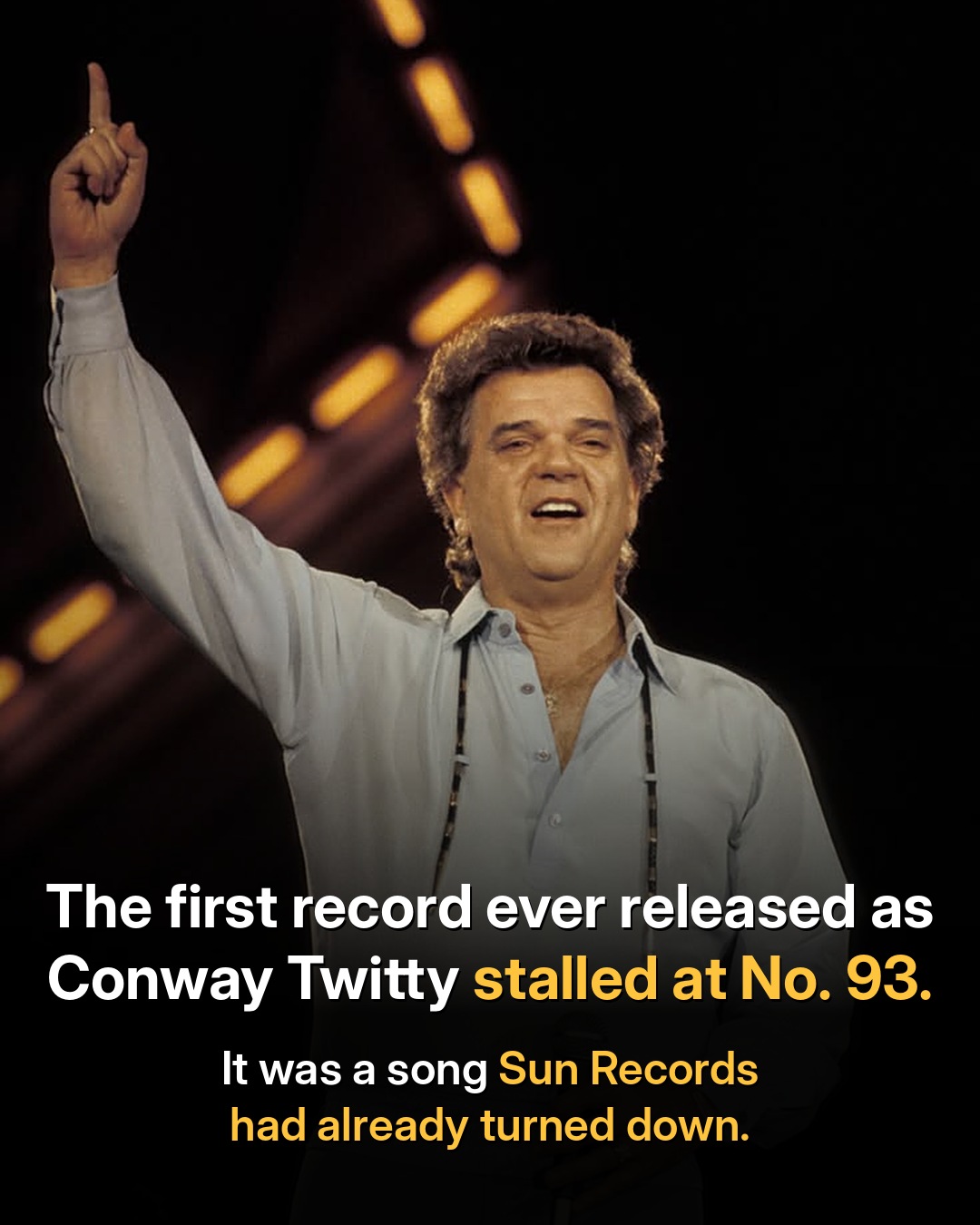
The song was “I Need Your Lovin’,” a rock and roll single Mercury Records put out in the spring of 1957, with “Born to Sing the Blues” on the flip side. It was the first record to carry the name Conway Twitty, and it was not really a new song at all. It was a reworked version of a demo that Sun Records in Memphis had already turned down.
The Sun Demo That Came Back
When Harold Jenkins got out of the Army in 1956, the music had changed. Elvis Presley was everywhere, and Harold, raised in Helena, Arkansas, put together a band and went to Memphis to try his luck with Sam Phillips at Sun Records.
He cut several sessions there. Among the songs he wrote and recorded was a wild little rocker called “Give Me Some Love.” Phillips liked Harold’s songwriting, but accounts agree he was not sold on the singing. To Phillips’ ears, Harold sounded too much like Elvis. None of Harold’s Sun recordings were released at the time.
The one thing Phillips did keep was a song. He took Harold’s “Rockhouse” for his publishing company and gave it to Roy Orbison, who released it as his second Sun single in September 1956. Harold’s song made it onto a Sun record. His voice did not.
A New Name and a Second Chance
By early 1957, Harold Jenkins had decided his own name would not stand out. The best-known account, told in Fred Bronson’s The Billboard Book of Number One Hits, says he found the new one on a map: Conway, Arkansas, and Twitty, Texas. Other versions of the story exist, but that is the one that stuck.
His manager, Don Seat, a man he had known in the Army, got the newly named Conway Twitty a contract with Mercury Records. For the first single, Conway went back to “Give Me Some Love” and reshaped it into “I Need Your Lovin’,” credited to Conway Twitty and Jimmy Paulman. The record was released in April 1957 as Mercury 71086.
By later accounts, he expected big things from it.
No. 93 and Out
“I Need Your Lovin'” reached No. 93 on the Billboard chart in May 1957. It was his first chart record, and it barely got there before it slipped away.
Part of the problem may have been the label. Writers at Vintage Rock have pointed out that Mercury was stronger in pop than in rock and roll at the time, and Conway’s records did not get much of a push. Rock and roll writer Dik de Heer heard something else on those Mercury sides: a young singer leaning hard on vocal tricks. In his words, “He was trying too hard.”
A second single, “Shake It Up” backed with “Maybe Baby,” followed in July 1957 and did no better. After one more session that October, Mercury dropped him.
What Came Right After
Conway Twitty headed north. He and his band had already found steady work at the Flamingo Lounge in Hamilton, Ontario, and he returned there in October 1957 with a lineup that included drummer Jack Nance.
In Hamilton, Conway Twitty and Jack Nance wrote “It’s Only Make Believe.” MGM Records signed him, and on May 7, 1958, he recorded it in Nashville. MGM put it out as the B-side behind a song called “I’ll Try,” and for a while nothing happened. Then disc jockeys flipped the record over and started playing the ballad.
In November 1958, “It’s Only Make Believe” hit No. 1 on the pop chart, and it soon topped the chart in the United Kingdom too.
Conway Twitty went on to become one of the biggest hitmakers in country music history, with dozens of No. 1 country songs. But the first time his name ever showed up on a Billboard chart, it was for a reworked Sun demo called “I Need Your Lovin’,” sitting at No. 93.