Scroll to the end of the article to hear the song.
On September 22, 1985, about eighty thousand people filled Memorial Stadium in Champaign, Illinois, for the very first Farm Aid. The lineup was huge, but one moment that day has stayed with country fans for decades. Four of the biggest names in the genre were supposed to stand side by side, and one of them was missing.
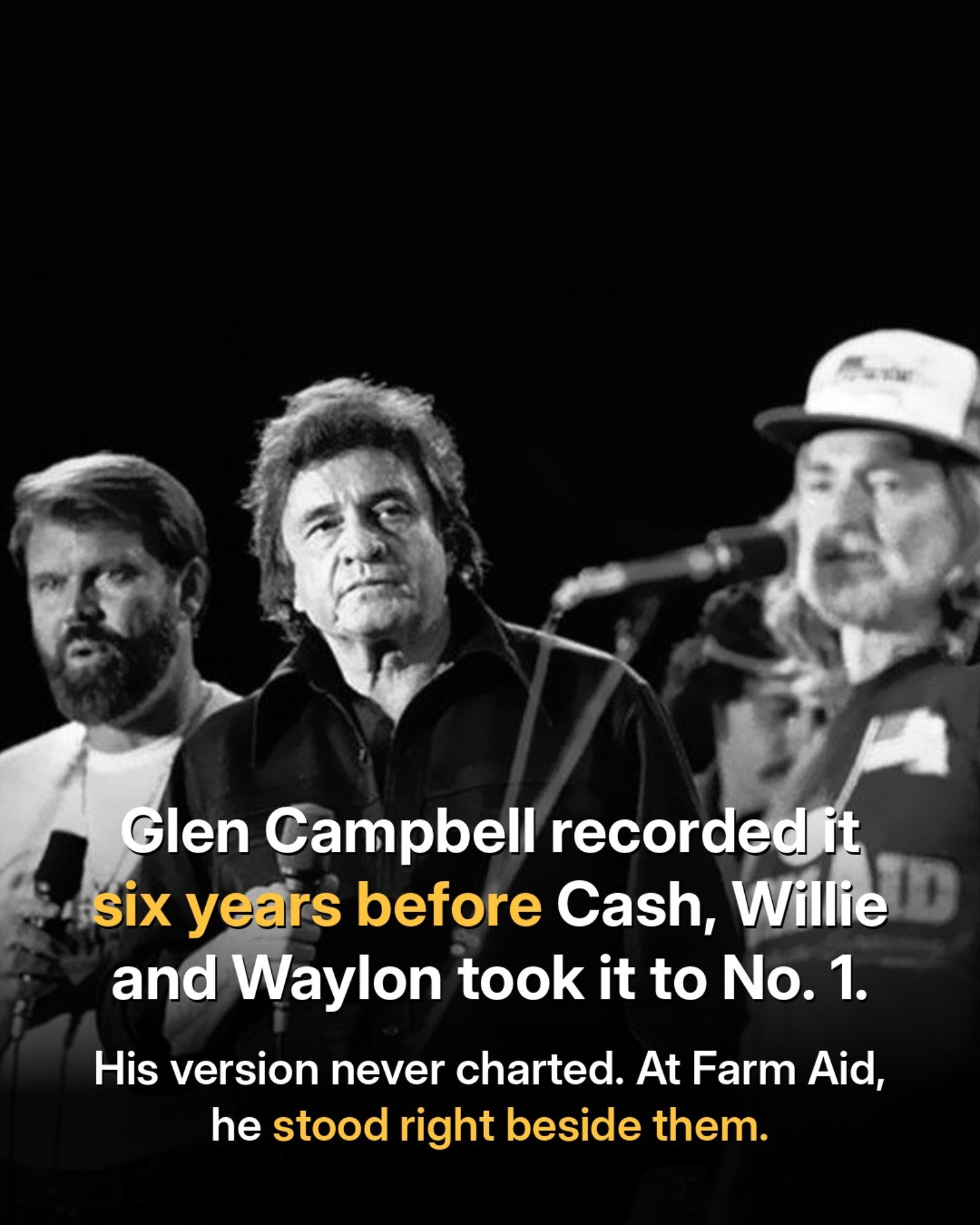
Kris Kristofferson wasn’t there. So Glen Campbell walked out and took his place next to Willie Nelson, Waylon Jennings and Johnny Cash. For most people in the crowd, he was a famous guest helping out. The song they sang that day had a longer history with Glen Campbell than most of them knew.
A Song That Started With a Dream
The story begins in London, years earlier. Songwriter Jimmy Webb, the man behind “Wichita Lineman” and “By the Time I Get to Phoenix,” was finishing his album El Mirage with producer George Martin. He had also been spending late nights drinking with his friend Harry Nilsson.
After one of those nights, Jimmy Webb fell asleep and had an incredibly vivid dream. In it, he was an outlaw on horseback, chased down, caught and condemned. When he woke up, he couldn’t shake the feeling that it had been a memory and not just a dream.
“Up until then, I hadn’t thought much about past lives.” — Jimmy Webb
Out of that dream came a song about one soul that keeps coming back. It lives as an outlaw, then as a sailor lost in a storm, then as a worker who falls into wet concrete while building a great dam, and finally as a man steering a ship across the stars. Each life ends, and each time the soul returns.
The Quiet Years
Jimmy Webb recorded the song himself in 1977. Then he brought it to his old friend Glen Campbell, who recorded it in 1978 and released it as the title track of his 1979 album, Highwayman.
It was a beautiful recording, and it went nowhere. The album didn’t chart, and the song was never released as a single. In Jimmy Webb’s own words, the song languished for years.
Glen Campbell didn’t let it go, though. He kept performing it in concert. Then in 1984 he played it for Johnny Cash, who was getting ready to make an album with three old friends: Willie Nelson, Waylon Jennings and Kris Kristofferson.
Four Men, Four Lives
The song didn’t win them over right away. It clicked when Marty Stuart, who was playing in Johnny Cash’s band, played it for all four of them together. They realized the song had four verses and four lives, and there were four of them. Each man could take one life. Johnny Cash reportedly asked for the last verse, about the ship among the stars, and nobody argued.
Their version of “Highwayman” came out in 1985. On August 17, 1985, it hit No. 1 on the Billboard country chart. It went on to win Jimmy Webb the Grammy for Best Country Song, and the four men later took their group name from it. They became The Highwaymen.
When the Song Met Its Past Life
That brings us back to Farm Aid, only about five weeks after the song reached No. 1. With Kris Kristofferson absent, the man who stepped into the empty spot was Glen Campbell, the singer who had carried “Highwayman” through its quiet years and first played it for Johnny Cash.
For a song about a soul returning in new lives, it was a fitting moment. The song’s earlier life and its new one were on the same stage at the same time, singing it together.
Why Fans Still Talk About It
The video of that performance still gets passed around, and it means more now than it did then. Johnny Cash, Waylon Jennings, Glen Campbell and Kris Kristofferson are all gone. Willie Nelson is the only one of the five men on that stage still with us.
Watching it today feels like seeing a song come full circle. A dream in a London hotel room turned into a forgotten album track, then a No. 1 hit, then the name of a legendary group. For a few minutes on a Farm Aid stage, the man who kept it alive got to sing it with the men who made it famous.
Some songs fade away. Others just wait for the right voices to find them.