Scroll to the end of the article to hear the song.
Say the name Waylon Jennings and most people picture the same thing. The black hat. The leather. The rough voice that helped turn Nashville upside down in the 1970s. The hell-raiser who even recorded a song called “Don’t You Think This Outlaw Bit’s Done Got Out of Hand.”
Other people know him for one story only: he was the man who should have been on Buddy Holly’s plane.
Both pictures are true, and neither one is the whole man. The part of Waylon Jennings that mattered most to him never showed up on a chart.
A Seat on a Plane, and a Joke He Never Forgot
In the winter of 1959, a young Waylon Jennings was playing bass for Buddy Holly on the Winter Dance Party tour across the frozen Upper Midwest. The tour bus kept breaking down, and the musicians were exhausted. Buddy Holly chartered a small plane to reach the next stop.
Waylon Jennings had a seat on that plane. But J.P. “The Big Bopper” Richardson was sick with the flu and miserable on the bus, so Waylon Jennings let him have it.
When Buddy Holly heard, he teased his friend, saying he hoped the bus froze up. Waylon Jennings laughed and shot back:
“Well, I hope your ol’ plane crashes.”
Early on February 3, 1959, the plane went down near Clear Lake, Iowa. Buddy Holly, Ritchie Valens, J.P. Richardson and the pilot, Roger Peterson, were all killed. Waylon Jennings carried that throwaway joke with him for the rest of his life.
The Rise of an Outlaw
He came back to music slowly, and when he did, he played it his own way. He fought for control of his own records at a time when Nashville producers usually made those decisions. In 1976, Wanted! The Outlaws, the album he made with Willie Nelson, Jessi Colter and Tompall Glaser, became the first country album ever certified platinum. Over his career, Waylon Jennings put 16 singles at No. 1 on the country charts.
The fame came with a dark side. By his own count, his cocaine habit once cost him around $1,500 a day. He was open about it later, and he never pretended it hadn’t happened.
The Turning Point Was a Little Boy
In 1984, Waylon Jennings rented a house in the Arizona desert and quit cold turkey. His wife, Jessi Colter, watched him go through it. He later said that their son, Waylon Albright “Shooter” Jennings, was the reason he stayed clean.
Then a quieter problem started to bother him.
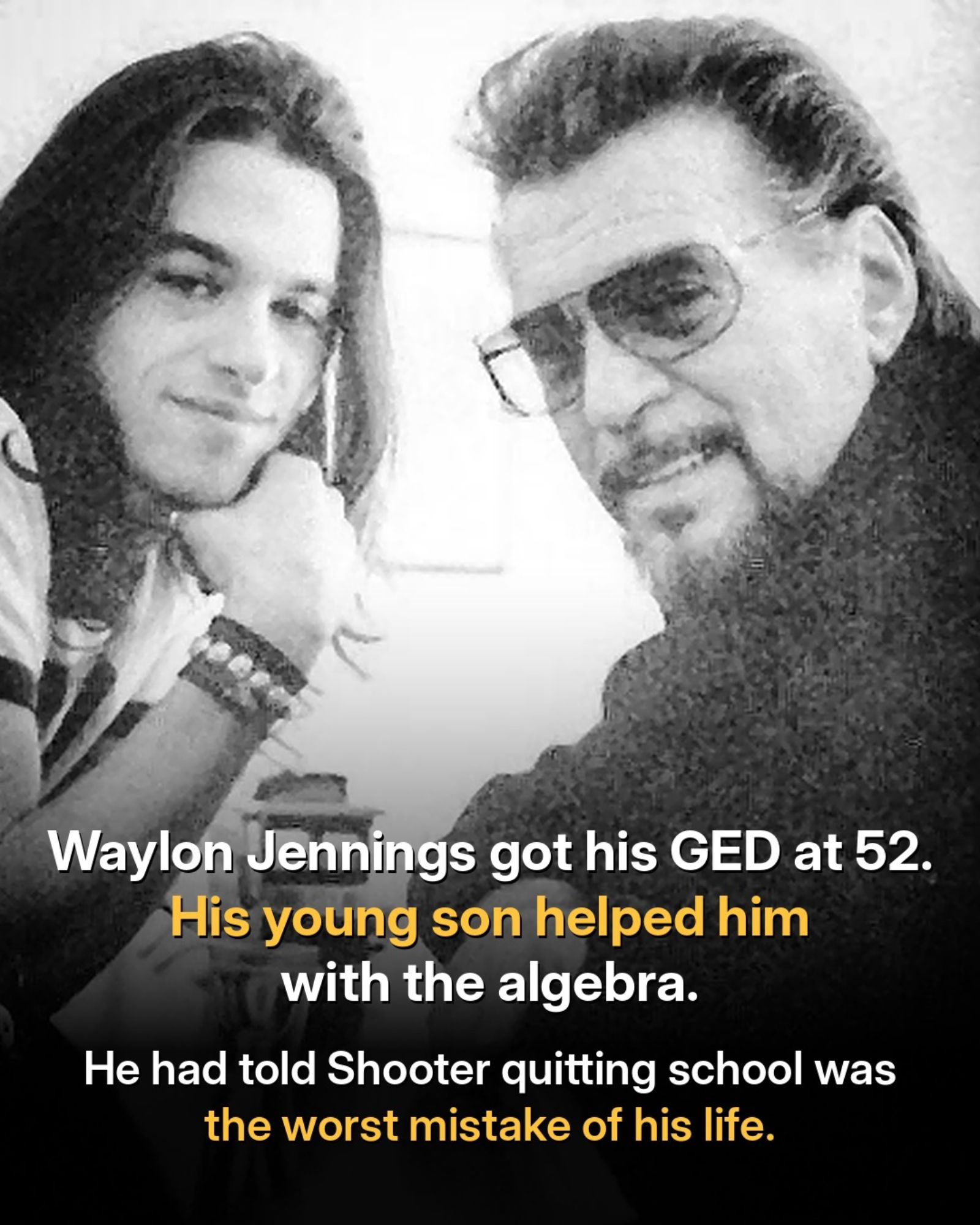
Waylon Jennings had left high school as a teenager to chase music. Now he kept telling Shooter that quitting school was the worst mistake he had ever made. But how much could those words mean coming from a dropout? He said he never liked people who didn’t practice what they preached.
Fractions, Algebra and a Promise
So in 1989, one of the biggest stars in country music sat down and studied for his GED. The one helping him was his young son.
“Shooter helped me with fractions and algebra.”
Waylon Jennings passed and earned his high school equivalency diploma at 52. He counted it among his greatest accomplishments, even with all the gold records on the wall.
“I did it for me and I did it for my son.”
After that, he spoke up for the GED program and encouraged kids to stay in school. Few people expected the original outlaw to become a role model for education, but he did.
The Last Years
His health got worse in his later years, and diabetes took more and more from him. In January 2000, he played the Ryman Auditorium in Nashville, and those shows were filmed as Never Say Die: The Final Concert. In October 2001, he was inducted into the Country Music Hall of Fame, though he did not attend the ceremony. In December, he lost his left foot.
On February 13, 2002, Waylon Jennings died peacefully at his home in Chandler, Arizona. He was 64.
More Than One Image
You don’t have to admire every chapter of the outlaw years. Waylon Jennings never asked anyone to. He told the hard parts himself.
But behind the black hat was a man who gave his seat to a sick friend, beat an addiction for his family, and went back to school at 52 so his boy would know he meant what he said.
The man who quit school at 16 went back so his son never would. That is the part of the Waylon Jennings story worth remembering.