Scroll to the end of the article to hear the song.
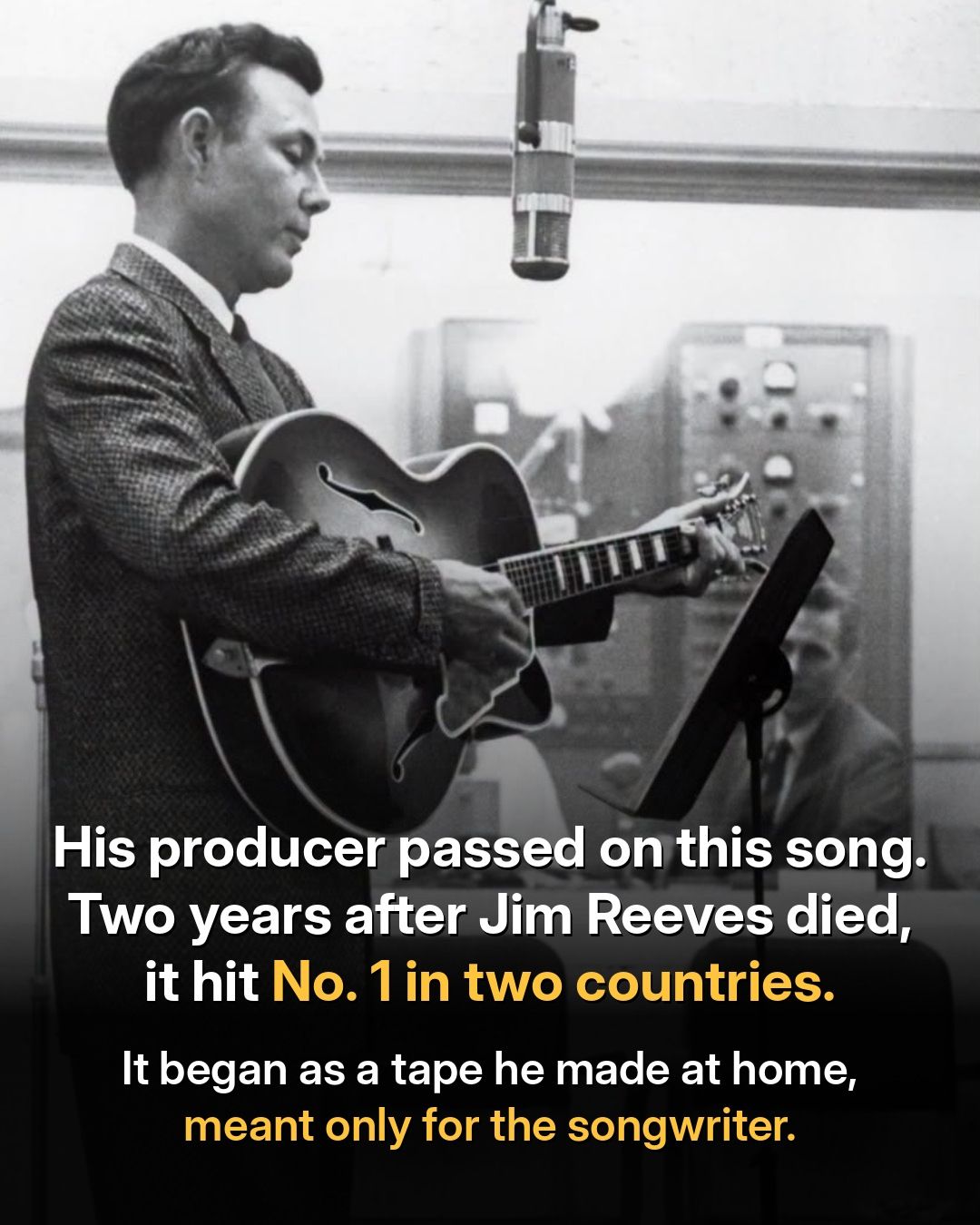
The song was “Distant Drums.” Jim Reeves recorded it at home for the woman who wrote it, and he never meant that tape for his fans. Two years after his death, it topped the American country chart for four weeks and the British pop chart for five.
A Cindy Walker song Chet Atkins turned down
Cindy Walker, the Texas songwriter behind so many country standards, came to Nashville in October 1961 for the annual disc jockey convention, mainly to get her songs recorded. She played Jim Reeves a few of them. One was “A Letter to My Heart.” Another was “Distant Drums,” a young man’s plea to a girl named Mary to marry him before he is called away to war.
Jim took both songs to Chet Atkins, who produced his sessions at RCA. Atkins agreed to record “A Letter to My Heart.” He did not think “Distant Drums” was a hit, and he declined it.
Accounts differ a little on the reason. Writer Alan Cackett, in a 1996 piece for Country Music International, says Atkins simply wasn’t convinced by the song. Other accounts frame it as Atkins feeling the timing was wrong for a release. What every account agrees on is that the song did not go out on an RCA record while Jim Reeves was alive.
The demo in the home studio
Jim Reeves had faith in the song anyway. Instead of letting it go, he recorded it himself in the studio at his home, with his band, the Blue Boys, playing behind him. It was a demo, a sample recording made so a songwriter could pitch the song to other singers.
He gave Cindy Walker a copy and told her she should have no trouble getting the song recorded. As far as he knew, that tape was hers to use, not something his fans would ever hear.
Later, the sleeve notes on the Distant Drums album suggested the song had been cut in a proper RCA session under Atkins. Cackett points out that RCA’s own files don’t back that up, and he concludes that the hit was built on the home demo.
Roy Orbison heard the same tape
Jim was right that someone would want it. Roy Orbison heard the demo around the time he was recording another Cindy Walker song, “Dream Baby,” and later recalled the moment in Wesley Rose’s office:
“Distant Drums just jumped out at me.”
Orbison recorded his own version on January 4, 1963. Monument released it that May, but as the B-side of “Falling.” Its best showing came in Australia, where it reached No. 3.
July 31, 1964
On the afternoon of July 31, 1964, Jim Reeves was flying his single-engine Beechcraft Debonair home to Nashville from Arkansas, where he had been working on a land deal. His pianist and manager, Dean Manuel, was with him. Near Brentwood, Tennessee, the plane ran into a storm and went down in the woods. Friends and fellow musicians joined the search, and the wreckage was found on the morning of August 2. Jim Reeves was 40 years old.
What Mary Reeves found
Fans wanted to hear anything new from him. His widow, Mary Reeves, worked with RCA to go through the recordings he had left behind, and among them was the home demo of “Distant Drums.”
The man who finished it was Chet Atkins, the same producer who had passed on the song. He kept Jim’s voice and built a fuller arrangement around it, adding lush strings to the bare demo. The overdub work was done in March 1965 and February 1966, and RCA released the single on March 8, 1966, with “Old Tige” on the flip side.
No. 1 on both sides of the Atlantic
In America, “Distant Drums” reached No. 1 on Billboard’s country singles chart in late May 1966 and stayed there four weeks. It also crossed into the pop chart, peaking at No. 45 on the Hot 100.
Britain took to it even harder. The record entered the UK chart that summer, reached No. 1 on September 22, 1966, and held the top spot for five weeks, spending 25 weeks on the chart in all. It was Jim Reeves’ first and only No. 1 single in Britain, and it remains his most successful posthumous single.
You will sometimes read that “Distant Drums” kept the Beatles’ “Yellow Submarine” and “Eleanor Rigby” out of first place. The chart record says otherwise: the Beatles single had already spent four weeks at No. 1 in August and September before Jim Reeves took over.
Roy Orbison’s version came first, but it is Jim Reeves’ recording that people remember. The young man in the song is pleading with a girl named Mary. The woman who went through Jim’s tapes and brought this one back to the world was named Mary, too.