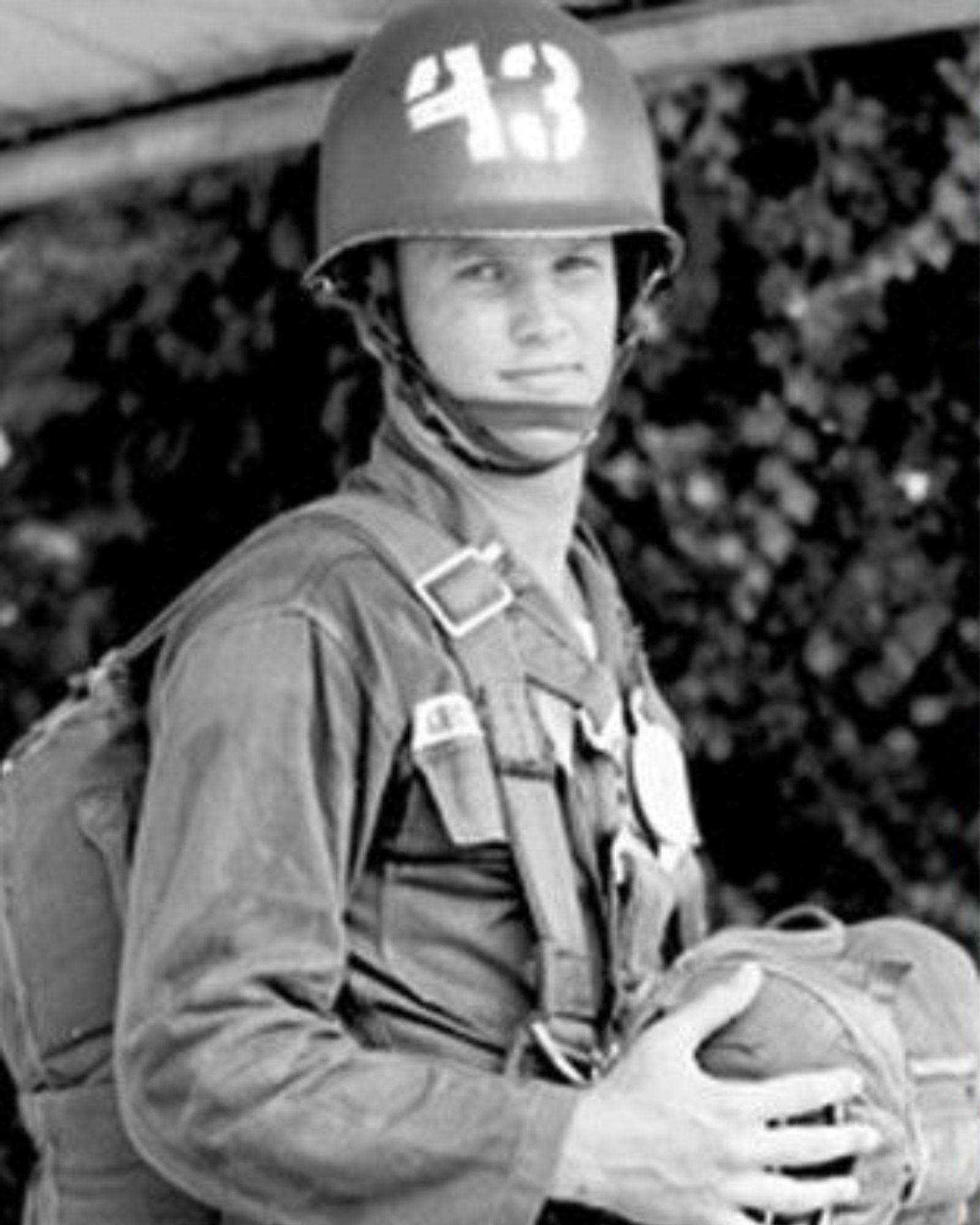
In 1965, Kris Kristofferson was an Army captain with a teaching appointment at West Point waiting for him. He turned it down, resigned his commission and moved to Nashville to write country songs. His family cut him off. Four years later, by most accounts, he set a National Guard helicopter down on the lawn of Johnny Cash’s house in Hendersonville, Tennessee, with a tape of his songs. Some of what is usually told about that day never happened.
The career everyone expected
Few people in Nashville had a resume like his. He had graduated from Pomona College in California, won a Rhodes Scholarship and earned a degree in English literature at Merton College, Oxford, in 1960. Then he did what the men in his family did and joined the Army.
His father, Lars Henry Kristofferson, had flown for the Army Air Corps and retired as a major general in the Air Force. His brother became a Navy aviator. Kris went through Ranger School, learned to fly helicopters at Fort Rucker, Alabama, and served in West Germany with the 8th Infantry Division.
When his tour ended, the Army offered him a post teaching English literature at the U.S. Military Academy. He later told Pomona College Magazine that he took the offer seriously.
I would have been a major and on my way.
He told a general that what he really wanted was to be a songwriter. The general, as Kristofferson remembered it, told him to follow his heart.
“A disgrace to us”
His parents did not see it that way. Kristofferson said they thought that somewhere between Oxford and the Army he had gone crazy. His mother told him nobody over 14 listened to that kind of music anyway. In a 1999 interview with Salon, he recalled being told not to visit any of the family’s relatives, because he was a disgrace to them. In a 2016 interview with Rolling Stone, he said she had called him an embarrassment to the family.
He did not describe it only as a wound. He said he had carried a lot of guilt about not becoming the senator or public servant everyone expected, and that his mother’s reaction cut him loose from it.
Being disowned was a real blessing at the time.
Ashtrays at Columbia, oil platforms in the Gulf
In Nashville he took a job as a janitor at Columbia’s recording studio, sweeping floors and emptying ashtrays while the stars he hoped to write for recorded down the hall. Bob Dylan was in that building in 1966 making Blonde on Blonde.
The janitor’s pay did not cover a family. So he went back to the one trade the Army had given him. He flew helicopters for Petroleum Helicopters out of Lafayette, Louisiana, ferrying crews to oil rigs in the Gulf of Mexico. He described working a week down in south Louisiana, sitting on an oil platform between flights, then driving back to Nashville for a week of pitching songs. He said he wrote “Help Me Make It Through the Night” sitting on top of one of those platforms, and that this was how he lived for roughly the last three years before people started recording his songs.
Those years cost him. His first marriage, to Frances Beer, ended in 1969.
The landing in Hendersonville
On weekends he flew for the Tennessee National Guard. In 1967 Johnny Cash had taken over an unfinished house on Caudill Drive in Hendersonville, overlooking Old Hickory Lake. Kristofferson had already handed demo tapes to Cash’s people at Columbia, and to June Carter, without much luck.
So during a Guard training flight, he left his route and brought the helicopter down on Cash’s lawn.
Cash told the story for years. In his version he was napping, June woke him to say some fool had landed a helicopter in their yard, and Kristofferson climbed out with a tape in one hand and a beer in the other.
Kristofferson always smiled at that. In a 2011 interview with Cowboys and Indians, he admitted the landing happened but said Cash was not even in the house, and June was not there either. He said he would never have been drinking while flying, and in another interview pointed out that a helicopter takes two hands and both feet. He also said the stunt did him no good.
What actually opened the door
The songs did. In July 1969, Cash brought Kristofferson onstage at the Newport Folk Festival. In 1970 Cash recorded “Sunday Mornin’ Comin’ Down,” Kristofferson’s portrait of a hungover man walking through an empty Sunday. It went to No. 1 on the Billboard country chart, and it won the Country Music Association’s Song of the Year award for 1970. Kristofferson later said that song was what let him stop working for a living.
Within two years his name was on records by Ray Price, Sammi Smith and Janis Joplin. At the Grammy Awards in March 1972, “Help Me Make It Through the Night,” the song he wrote on an oil platform, won Best Country Song.
The mother who came around
The estrangement did not last forever, though it lasted as long as he was struggling. Kristofferson was honest that success was part of what changed things. He said his father told him he would never understand him, but understood he had to do what he had to do, the same way nobody could have stopped his father from flying. He added that his father was a hard man to please, and doubted there would have been any reconciliation if he had failed.
His mother changed the most. By the time she died, he said, she was coming backstage and hugging Johnny Cash. She was also calling radio stations and giving them hell when they did not play her son’s songs.