In the fall of 2001, Toby Keith wrote “Courtesy of the Red, White and Blue (The Angry American)” in about 20 minutes, scribbled on the back of a fantasy football sheet. It would become the defining song of his career. For months, he had no intention of letting the public hear it.
The song was not written for radio, for awards shows or for the charts. It was written for a father who had died six months earlier, and for the young men and women who were about to go to war.
The Father Who Flew the Flag Every Day
Toby Keith was born Toby Keith Covel in Oklahoma. His father, Hubert Keith “H.K.” Covel Jr., served as a private first class in the U.S. Army in the 1950s and lost his right eye during a training exercise. He came home and spent the rest of his life as the kind of man who raised the American flag at his house every single day.
On March 24, 2001, H.K. Covel was driving on Interstate 35 in Oklahoma when his car was sideswiped and pushed across the median, where a charter bus struck it. He was 67. Toby was 39, already one of the biggest stars in country music, and suddenly without the man who had taught him what the flag meant.
Years later, the family received a wrongful death settlement after it emerged that the bus had faulty brakes. In 2001, there was only the loss.
Twenty Minutes the Week After 9/11
Six months later, on September 11, the towers fell. Toby later explained that he kept thinking about how his father would have reacted. H.K. Covel, he said, would have been angry.
The week after the attacks, while he was sorting out his fantasy football team, the words came in one burst. He wrote them on the back of the fantasy sheet in roughly 20 minutes. He titled it “The Angry American.” Where much of the music that fall was about grief and prayer, this one was about anger and resolve.
He knew exactly what kind of song it was. In a 2021 interview, he said he had known from the start it would be polarizing, a lightning rod.
A Song Only for the Troops
Toby did not take the song to his label. He did not plan to record it at all. He played it only in front of service members.
One of its earliest performances, according to the accounts of that time, came at the Pentagon, for a group of Marines preparing to deploy to Afghanistan. His band had not learned it yet, so he stood up alone with an acoustic guitar and played it for them.
In a later interview with TIME, he explained his reason plainly. He said he wrote it so he would have something to play for the country’s fighting men and women.
The General Who Changed His Mind
Among those who heard it was Gen. James L. Jones, then Commandant of the Marine Corps and later Supreme Allied Commander in Europe. Jones did not treat it as a novelty. He described it in remarkable terms.
“The most amazing battle song I’ve ever heard in my life.”
Jones told Toby he did not really have a choice. It was his job as an entertainer, the general said, to lift the morale of the troops, and if he wanted to serve, this was how he could do it.
Toby thought it over and prayed about it. His answer was simple. If the song meant that much to those men, he would do it. His label suggested a new title, “Courtesy of the Red, White and Blue,” and he kept “The Angry American” in parentheses.
Radio, a No. 1 Hit and a Fight With ABC
The song went to radio on May 27, 2002, as the lead single from the album Unleashed. It debuted at No. 41 on Billboard’s country chart and reached No. 1 for the week of July 20, 2002. It also climbed to No. 25 on the Billboard Hot 100, his biggest solo pop crossover up to that point.
Not everyone welcomed it. ABC had planned to include Toby on its Fourth of July broadcast, “In Search of America.” In June 2002, backstage at the CMT Flameworthy awards, Toby said anchor Peter Jennings had personally kept the song off the network. By his account, he had been asked to soften the lyrics or pick a different song, and he refused both.
ABC told a different story. A network spokeswoman said producers, not Jennings, had made the decision, and that the song was too angry to open a show meant to celebrate American strength and diversity. The two sides never fully agreed on what happened. Toby did not appear on the broadcast, and he did not change the song.
The Tribute That Became 18 Tours
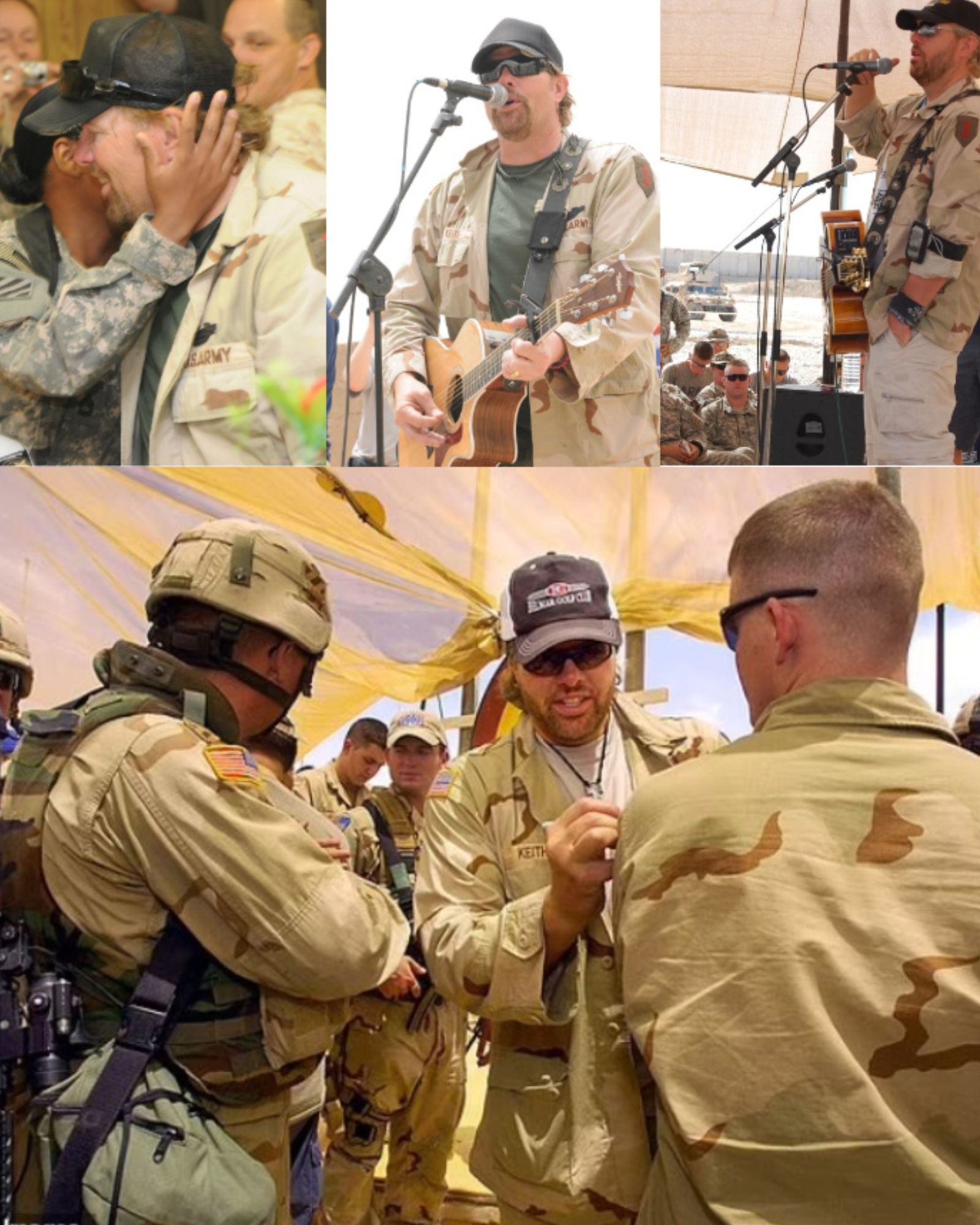
That same year, Toby Keith made his first USO tour. He saw it at the time as a one-time gesture in honor of his late father, the Army veteran. He told the USO that after his father died, he wanted to do something to honor his service.
It did not stay a one-time trip. Over the next two decades he made 18 USO tours and, according to the USO, performed for more than 250,000 service members. He went where few entertainers went. On his seventh tour, in April 2009, he played 15 shows in five days at small forward operating bases and combat outposts in Afghanistan, at one point within six miles of the Pakistan border, often traveling with gunship escorts.
Toby Keith died of stomach cancer on February 5, 2024, at the age of 62. Within days, the song he had once refused to record was back on Billboard’s country chart.