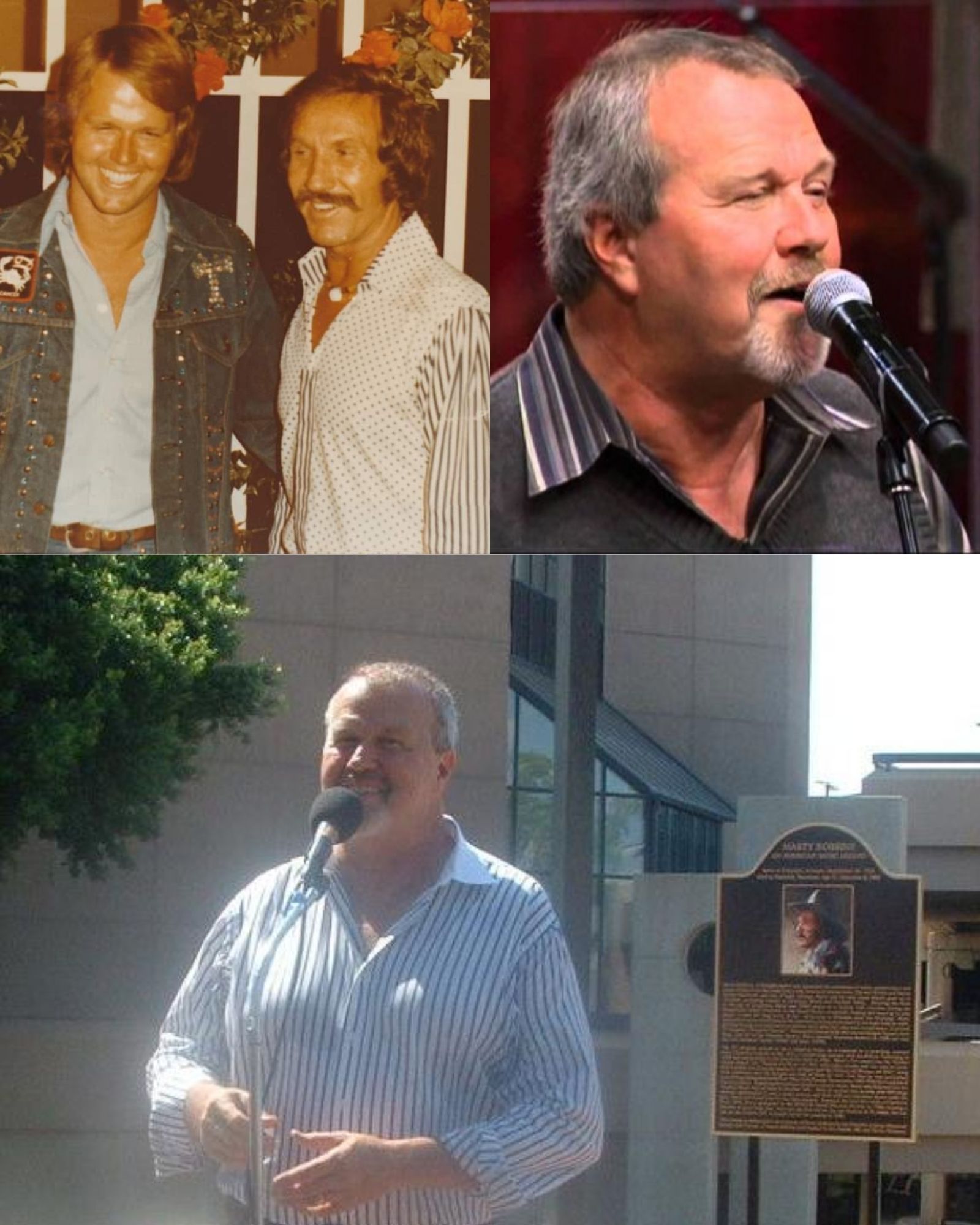
When Marty Robbins died in December 1982, his son Ronny was 33. He had grown up beside his father’s music, and he knew how much of his father’s life had been spent away from home. For three years after the funeral, Ronny went back out with the Marty Robbins Band. Then, in 1985, his daughter Courtney was born, and he stopped touring for good.
Eight weeks in the fall of 1982
The last months of Marty Robbins’ life looked like a comeback. “Some Memories Just Won’t Die” had reached the country Top Ten in May 1982. In October, Billboard gave him its Artist Resurgence Award for the biggest career revival of the year. He had also filmed a small role in Clint Eastwood’s Honkytonk Man.
That same October, at the CMA Awards, Eddy Arnold made sure Marty was in the building without telling him why. The Country Music Hall of Fame induction was kept secret until it was announced live on the broadcast. Marty was visibly stunned and told the audience he felt other people deserved it before he did.
Ronny was not in the hall. He watched on television at a CBS party. Decades later, speaking from his home in Franklin, Tennessee, he said the honor meant a great deal to his father, and admitted the CMA had not always been kind to him.
On November 7, 1982, Marty drove a Junior Johnson-built Buick Regal in the Atlanta Journal 500. It was his last NASCAR race.
Six days at St. Thomas
On December 2, Marty was admitted to St. Thomas Hospital in Nashville with chest pains. Tests showed a massive heart attack, his third in 13 years. His first had come in August 1969, and in January 1970 he had undergone bypass surgery that was still considered experimental. This time surgeons performed an emergency quadruple bypass.
He came through it. He was able to smile and squeeze a nurse’s hand, and his doctors gave him a 50-50 chance and spoke of his will to live. Then his condition turned. Marty Robbins died at 11:15 p.m. on Wednesday, December 8, 1982. He was 57. His wife Marizona, his daughter Janet and his son Ronny were with him. At WSM, disc jockey Chuck Morgan said listeners were calling in, hoping to hear that the news was not true.
The boy in the front seat
Ronny was born in 1949 and was four when the family left Phoenix for Nashville in 1953. When he was a preteen, back around Cave Creek, Arizona, Marty would sometimes let him take the wheel while he went rabbit shooting.
Ronny was also there for the song that defined his father. He remembered the family’s turquoise Cadillac, his mother driving, Ronny in the front seat and Marty in the back, writing “El Paso.” He believed his father worked on it over two consecutive Christmas trips. Marty later cut six or seven minutes of verses before recording it.
Ronny tried his own career. In 1969 Columbia released an album billing him as Marty Robbins Jr., and father and son sang “Big Mouthin’ Around” together on television. But Ronny never warmed to touring.
Three years with his father’s band
After Marty’s death, Ronny went on the road with the Marty Robbins Band. He kept at it for three years. In 1985, when Courtney was born, he quit. Speaking with Marty Robbins biographer Diane Diekman in 2017, he explained why in a single sentence.
I knew what it felt like for Dad to be gone 200 days a year.
He did not want his daughter to grow up knowing that feeling. In 1988 he bought an office building as what he thought would be a one-year investment. Managing it became his long-term job.
Guarding the name
From the late 1980s, Ronny ran Marty Robbins Enterprises, the family company that approves uses of his father’s name and likeness. The sound recordings were never his to control; Columbia, later Sony, owns the masters from Marty’s years under contract. What Ronny could protect was the name, the face and the television shows.
He did that carefully. He released The Drifter and The Best of the Marty Robbins Shows on VHS in the early 1990s, and later partnered with Country’s Family Reunion to issue the Marty Robbins Spotlight programs. He passed on spending $32,000 in licensing advances to put more shows on DVD.
He also pushed back when he thought the name was being cheapened. His attorney sent a cease-and-desist letter over unauthorized merchandise. When a man in Phoenix began raising money to rename Grand Avenue after Marty, Ronny got an injunction to stop the collection. When a food company wanted “El Paso” for advertising but asked to change the lyrics, he told the Phoenix New Times he had to look at it long and hard: the money could be substantial, but the song would be diluted.
I’ve got to protect my father’s name and image.
For years the family also kept a Marty Robbins museum near Nashville. It held his guitars, his Honkytonk Man costume, lyrics scribbled on Ramada Inn notepads, and the last car he raced, a month before he died.
Back on the stage, now and then
Ronny did not disappear from music entirely. On Country’s Family Reunion, he has sung “Big Iron” and “El Paso,” telling stories about his father between songs.
In 2025 the Marty Robbins Estate sold a catalog of his songs, including “El Paso” and “Big Iron,” to Anthem Music Publishing. Ronny’s part had been different: keeping the name clean and the memory in front of people. In his 2017 conversation with Diekman, he thanked her readers for helping keep his dad’s memory alive.
He never went back on the road.