Scroll to the end of the article to hear the song.
Some songs start with a heartbreak. One of the most famous songs in country music history started with a mistake: a tape that played the wrong way.
A Strange Sound in Landsberg
In the early 1950s, Johnny Cash was not a star. He was a young airman in the United States Air Force, stationed in Landsberg, West Germany. In his free time he played music with a group of fellow servicemen who called themselves the Landsberg Barbarians, and he bought a reel-to-reel tape recorder to capture what they played.
One day, a tape of the band came out of that recorder backwards. Johnny Cash heard a low, haunting drone full of weird chord changes. In his autobiography he described it as something that sounded like “spooky church music.”
Johnny Cash kept that sound in his head for years. He later said he always wanted to write a love song around it.
The Girl Waiting at Home
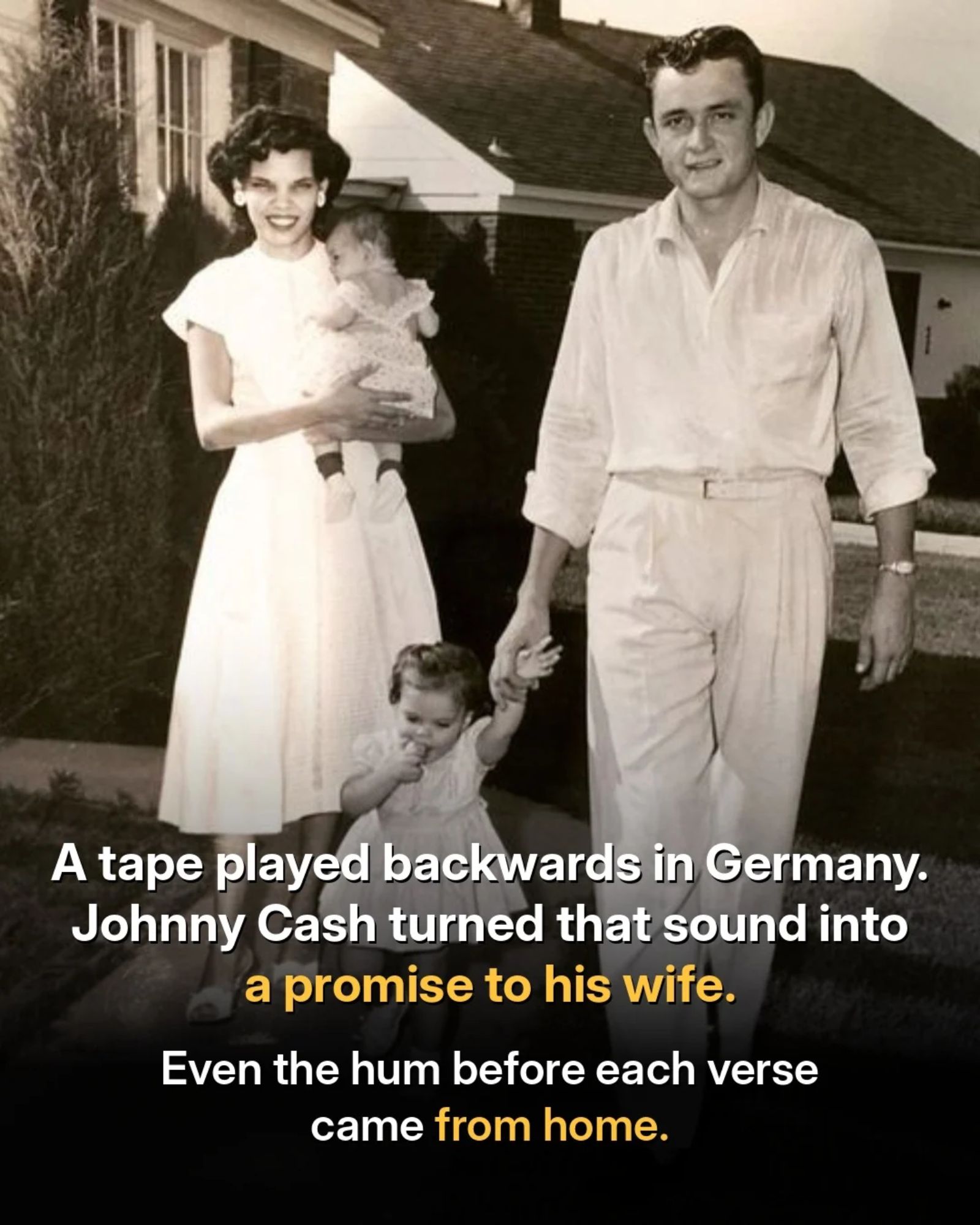
Before he shipped out, Johnny Cash had met a young woman in San Antonio, Texas, named Vivian Liberto. They had only dated briefly.
So he wrote to her. Over his time overseas, he sent Vivian Liberto more than a thousand love letters. Long before the world knew his voice, she knew his handwriting.
They married after he came home, and soon after that, everything changed. Johnny Cash signed with Sun Records in Memphis, and by 1956 he was on the road, opening shows for Elvis Presley. Temptation came with the tour.
A Promise Written on the Road
One night in Gladewater, Texas, with Carl Perkins nearby, Johnny Cash finally gave that old backwards sound some words. He first called the song “Because You’re Mine.” Carl Perkins told him another phrase from the song would make a better title. Johnny Cash agreed.
Years later, in a 1997 interview with NPR’s Fresh Air, he was asked whether he had been thinking of his own life when he wrote it. His answer was simple and honest:
“It was kind of a prodding myself to play it straight, Johnny.”
The song he wrote is a vow. A man far from home promises to guard his heart, to stay alert to temptation, and to stay true to the woman he loves. He insists that being faithful to her comes easy. It is not a song about a perfect man, but about a man reminding himself who he wants to be.
Even the soft hum before each verse had a story. Johnny Cash said he picked it up from a doctor back in his hometown who was always humming.
The Hit He Almost Stopped
Johnny Cash recorded the song at Sun Studio in Memphis on April 2, 1956. Producer Sam Phillips wanted it faster than the slow ballad Johnny Cash first had in mind. To get a sharper rhythm, Johnny Cash slipped a piece of paper through the strings of his guitar.
When he heard the result, he wasn’t sure. He actually asked Sam Phillips not to release it. Sam Phillips told him, “Let’s give it a chance.”
The song was released on May 1, 1956. It became the first No. 1 country hit of Johnny Cash’s career. The song was “I Walk the Line.”
What the Song Still Holds
Johnny Cash died on September 12, 2003. Vivian Liberto lived two more years. After she was gone, her memoir was published with some of those letters inside, and in 2020 their four daughters, Rosanne Cash, Kathy Cash Tittle, Cindy Cash and Tara Cash Schwoebel, helped tell her story in the documentary My Darling Vivian.
The melody of this song was born in Germany, in the very same years Johnny Cash was mailing more than a thousand love letters home to the woman it would be written for.
A tape ran backwards. A promise ran forward. And every time someone presses play, that young airman’s vow is heard again.
Which Johnny Cash song means the most to you now that you know the story behind it?