Scroll to the end of the article to hear the song.
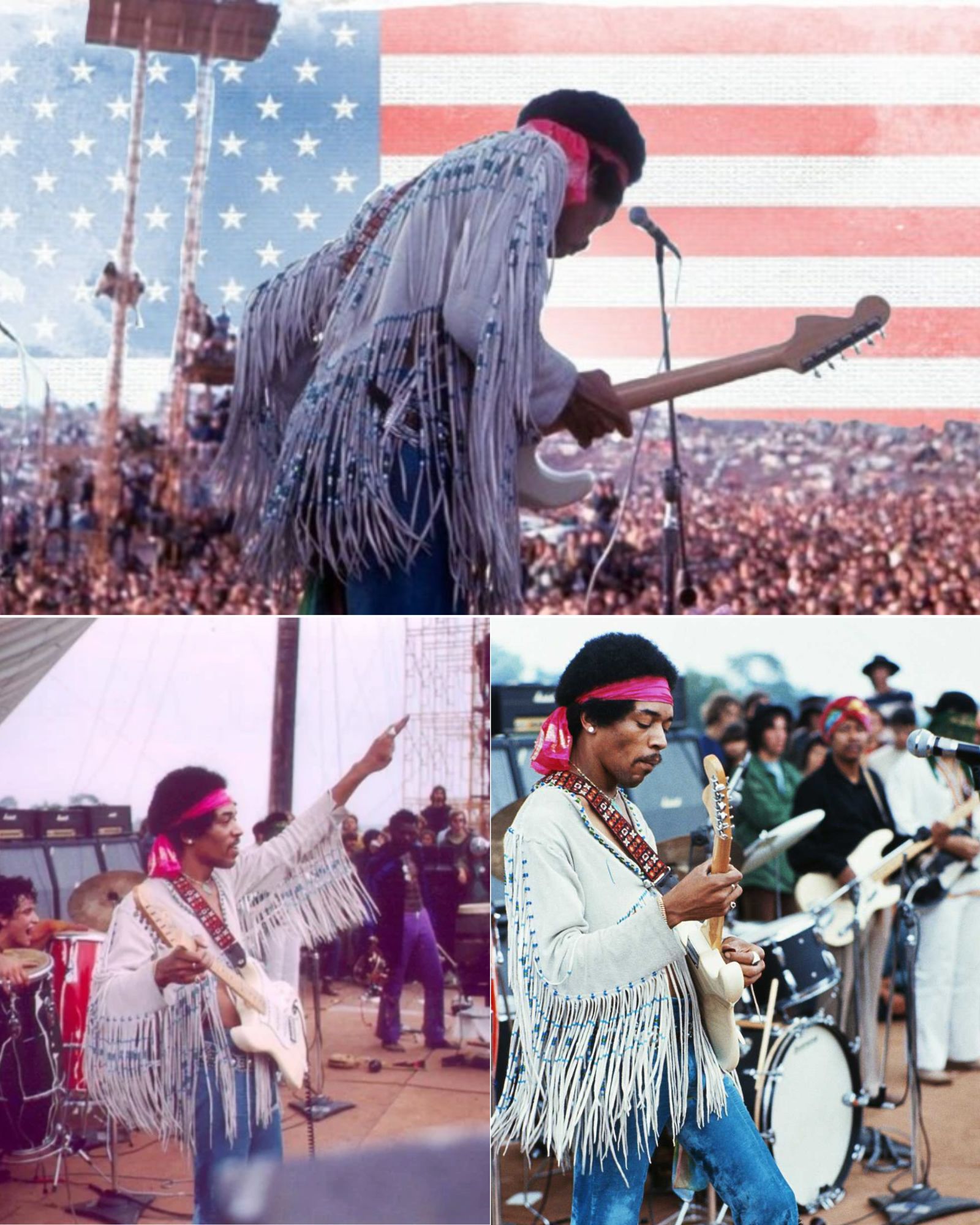
Some of the most famous minutes of Woodstock happened on a Monday morning, after most of the crowd had packed up and left. Jimi Hendrix took the stage around 9 a.m. on August 18, 1969, and somewhere late in a two-hour set he played “The Star-Spangled Banner” for the people who were still standing in the mud.
Estimates of how many stayed run from about 30,000 to 40,000. The Bethel Woods Center for the Arts, which sits on the old festival grounds, puts it at roughly 40,000, out of a crowd once counted near half a million.
Why the Biggest Star Played at Breakfast Time
Hendrix was supposed to close the festival on Sunday night. Rainstorms, traffic and technical trouble pushed the whole schedule back by hours. He was offered the chance to go on at midnight, but he wanted to be the final act, and by the time his turn came the sun was up. He was also the best-paid performer of the weekend, at $18,000.
He wasn’t even the organizer’s first choice for the closing slot. Michael Lang later said he had wanted Roy Rogers to end Woodstock with “Happy Trails.”
“Roy Rogers had turned me down. I wanted ‘Happy Trails’ to close the festival.” — Michael Lang
A Band With Soldiers on the Stage
Hendrix did not bring the Jimi Hendrix Experience. That trio had broken up in June. Instead he walked out with a new, loose group he called Gypsy Sun and Rainbows, and when the announcer introduced the old band name, Hendrix corrected him from the stage.
Two of the men behind him went back to his Army days. Hendrix had enlisted in 1961 and earned his jump wings with the 101st Airborne at Fort Campbell, Kentucky. There he met bassist Billy Cox, and the two played clubs around Clarksville and Nashville. Guitarist Larry Lee, a friend from those Tennessee years, had been home from Vietnam only about two weeks when the call came to join the band. He later said he had just come back from the unemployment office when the phone rang.
“You Can Leave If You Want To”
The set was long and uneven. The new band had barely rehearsed, and as the morning wore on people kept drifting toward the exits. At one point Hendrix told the crowd they were free to go: “We’re just jamming, that’s all.”
After more than an hour he reached “Voodoo Child (Slight Return),” the song that usually closed his shows. He said goodnight while the band kept playing. Then, instead of stopping, he started the anthem.
The Anthem Nobody Planned
It wasn’t on the set list. Billy Cox said so, and drummer Mitch Mitchell wrote in his memoir that the band had not rehearsed or planned it. Still, it was not a whim. Hendrix had been playing the anthem at concerts for about a year.
At Woodstock it ran about four minutes on his white Fender Stratocaster. He played the melody straight at first. When he reached “the rockets’ red glare,” the guitar broke into dive-bombing feedback, explosions and wailing sirens. Next he slipped in a few bars of “Taps,” the bugle call played at military funerals, before going back to the melody and finishing the anthem in full, holding the note on “free.”
Larry Lee, playing beside him, later said that he had to shake his head to make sure he wasn’t back in Vietnam. Out in the field, a 23-year-old Army veteran named Marc Leepson, discharged about a month earlier, was watching. Leepson, who later wrote a biography of Francis Scott Key, remembered it this way:
“Our mouths were hanging open.”
What Hendrix Said About It
Three weeks later, on September 9, 1969, Hendrix sat down with Dick Cavett, who asked him about the controversy over his anthem.
“All I did was play it. I’m American, so I played it. They made me sing it in school, so it was a flashback.” — Jimi Hendrix
Cavett pointed out to viewers that his guest had served in the 101st Airborne. When he added that playing the anthem in any unorthodox way brings a guaranteed share of hate mail, Hendrix cut in. It wasn’t unorthodox, he said. “I thought it was beautiful.”
Many people have since called it a protest against the Vietnam War. Hendrix himself never said so. In his own words, he was an American playing his country’s song.
The Morning That Became the Moment
Most Americans never heard it live. They met it in the 1970 documentary Woodstock, which won the Academy Award and ended with Hendrix’s performance. By then the man who played it had little time left. Jimi Hendrix died in London on September 18, 1970, thirteen months after that Monday morning.
He played the anthem at shows until the end. His last known performance of it came in Hawaii on August 1, 1970. But the version people remember is the one he gave a thinned-out field, after the festival was supposed to be over.