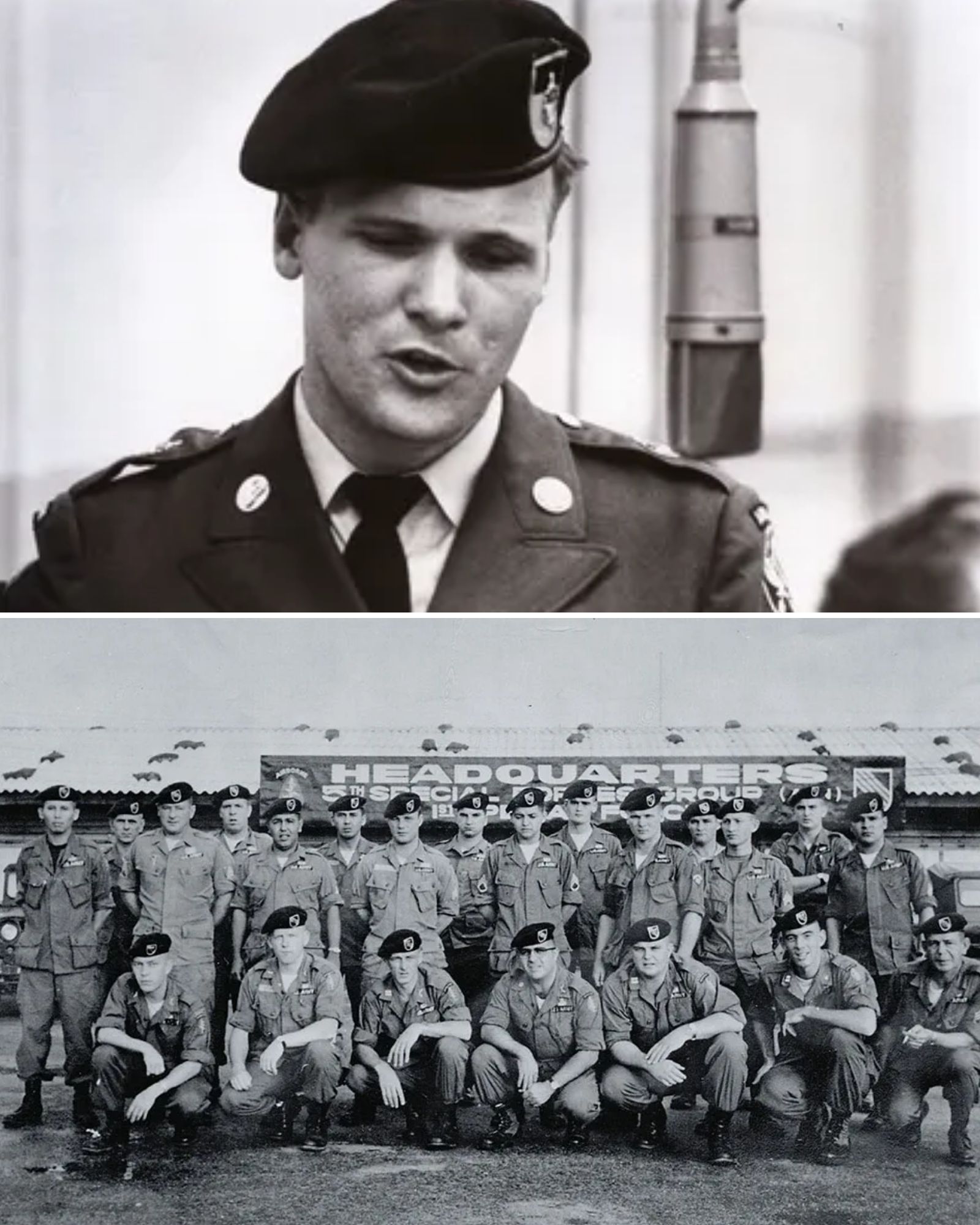
In the spring of 1965, Lavona Sadler was at her mother’s house in Pennsylvania, getting her infant son’s afternoon bottle ready, when she switched on the national news around six o’clock. A moment later her husband was on the screen. Staff Sgt. Barry Sadler, a Green Beret medic serving in Vietnam’s Central Highlands, was smiling into the camera and singing “The Ballad of the Green Berets,” a song almost nobody outside the Army had heard. She was alone in the house, with no one to call into the room. Less than a year later, that song would be the best-selling single in America.
A Song Built on Barracks Steps
Sadler could not read music and had never taken a lesson. After four years in the Air Force, he enlisted in the Army in 1962 and volunteered for Airborne and Special Forces. Earning his jump wings at Fort Benning in early 1963 meant so much to him that he decided to write a song built around a paratrooper’s silver wings.
He started it during Special Forces medic training at Fort Sam Houston in San Antonio and kept rewriting it for two years. He later told several colorful versions of how it was written, then admitted to a journalist friend that the truth was simpler: he had revised it in several places, including Vietnam.
A young public information officer at Fort Bragg, 2nd Lt. Gerald Gitell, had Sadler cut a rough demo and mailed it to New York songwriter and producer Chester Gierlach, who signed Sadler to a songwriter’s contract in July 1964. Then nothing happened. In late December 1964, Sadler said goodbye to his wife and baby son and shipped out to Vietnam.
The Clip From Saigon
Sadler ended up with Detachment A-216 at Camp Hardy in Plei Do Lim. The team’s medics treated Montagnard fighters and their families almost every day, doing minor surgery, inoculations and even basic dental work. In March 1965 alone they logged more than a thousand outpatient procedures. Sadler was known as the guy with the guitar.
That March he was ordered to the Army’s public information office in Saigon and told to write a song for a general’s retirement party. While he was there, the office filmed him singing “The Ballad” in front of a bunker and sent the footage to news outlets. A few days later it reached the evening news, and Lavona’s mother’s living room.
Mid-May, Outside the Wire
In mid-May, on patrol with Montagnard troops, Sadler walked into a punji stick, a sharpened stake planted as a booby trap. It tore into the side of his left knee, and the wound became seriously infected.
He was treated at the field hospital in Nha Trang, then flown on an Air Force C-119 to the hospital at Clark Air Base in the Philippines. He managed to bring his guitar, and during his recovery he sang “The Ballad” for the other wounded men on the ward. His tour, barely five months old, was over.
The Man in the Hospital Bed
Sadler left Clark on July 20, 1965, and flew back to Fort Bragg. He had lost more than 40 pounds and weighed about 140. When Lavona came to the hospital, she walked right past his bed. She only stopped when he called out her name.
“I honest-to-gosh didn’t recognize him at all.” — Lavona Sadler
The recovery took months, but the leg healed. Gierlach was a friend of Robin Moore, whose book The Green Berets had come out that May. At Moore’s suggestion the title became plural to tie it to the book, and Moore wrote a new third verse in exchange for half an interest in the song. By November 1965, Sadler’s photo was on the cover of the paperback edition.
Twelve Songs in One Day
On December 2, 1965, Sadler flew to New York and signed with RCA Victor for a $500 advance. At about 8 a.m. on Saturday, December 18, he walked into Studio A at RCA’s building on East 24th Street in his Army uniform. Arranger Sid Bass had a 15-piece orchestra and a male chorus waiting. He recorded four songs before lunch. He sang “The Ballad” right after the break, and he later wrote that the musicians and executives behind the glass stirred when he started it. The session ended at 11 that night with twelve songs finished.
Five Weeks at No. 1
RCA released the single on January 11, 1966. On January 30, Sadler sang it on The Ed Sullivan Show. On March 5, it reached No. 1 on the Billboard Hot 100 and stayed there five weeks. It also topped the easy listening chart and climbed to No. 2 on the country chart. The single sold some nine million copies. Billboard first placed it tenth on its 1966 year-end chart, then revised its rankings, and it has since been recognized as the top Hot 100 song of the year.
What the Song Cost Him
The Army took Sadler off regular duty and sent him around the country as a living recruiting poster, a role he came to hate. He left the service in May 1967 and never had another hit close to it. In 1971 he told journalist Robert M. Powers:
“I wish that I’d never, ever written that stupid song.”
On September 7, 1988, Sadler was shot in the head while riding in a taxi in Guatemala City, where he had lived since 1984. The circumstances were never settled. He spent his last 14 months in VA hospitals and died at the Alvin C. York VA Medical Center in Murfreesboro, Tennessee, on November 5, 1989, four days after his 49th birthday.
The song outlived him. It is still played for Special Forces trainees at Fort Bragg, at Green Beret reunions and at the funerals of men who wore the beret.