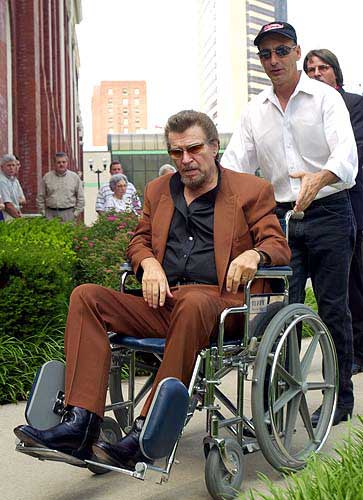
On the morning of July 3, 2001, a long caravan of limousines pulled up to the side door of the Ryman Auditorium in Nashville. Out of the back of the longest stretch limousine of the day, Waylon Jennings worked his way into a wheelchair. He had come to say goodbye to Chet Atkins, the man who brought him to RCA, produced his early hits, and spent years arguing with him over how those records should sound.
A Body That Was Giving Out
Waylon was 64 that summer. Diabetes had been wearing him down for years, and the circulation problems that came with it had made walking difficult. He had already gone through surgery in April 2001 for peripheral vascular disease. He and his wife, Jessi Colter, had sold their Nashville home and moved to Chandler, Arizona. Nashville was no longer home, and he came back for this anyway.
He was not the only one who struggled to get through the door. Chet’s own generation turned out in force that morning. Kitty Wells walked in slowly beside her husband, Johnny Wright, who leaned on a cane. Bill Carlisle, 92 years old, the man whose Knoxville radio show had given a teenage Chet one of his first jobs, arrived in a wheelchair too.
The Phone Call in 1965
The connection between the two men went back 36 years. In the early 1960s, Waylon was a singer working the clubs around Phoenix, still carrying the weight of the 1959 plane crash that killed Buddy Holly. Bobby Bare heard him, called Chet Atkins at RCA, and told him to sign the young Texan, even though Bare knew he was recommending his own competition.
Chet called. Waylon later described that phone call as hearing from God’s right hand in country music, and said the most important thing in his life became impressing the man on the other end of the line.
He signed with RCA in 1965. Over the next five years, Chet produced more than fifteen of his top-20 hits, including “Only Daddy That’ll Walk the Line” and “Brown Eyed Handsome Man.”
The Years of Pulling Apart
The partnership was productive, and it was also a constant tug of war. Chet built his records with Nashville’s polished session players and the smooth sound that had kept country music selling through the rock and roll years. Waylon wanted his own road band, the Waylors, in the studio, and he wanted his records to sound like the man who sang them.
By 1972, Waylon was frustrated enough that he talked about quitting. He hired New York manager Neil Reshen to renegotiate his contract. In his autobiography, Waylon wrote that the final meeting took place in Chet’s office and stalled over $25,000, with nobody saying a word for several minutes, until Waylon got up to go to the bathroom. When it was over, he had creative control of his own music.
The next year, Chet hesitated over an album built almost entirely on songs by an unknown Texas writer named Billy Joe Shaver. Waylon used his new freedom, brought in Tompall Glaser to co-produce, and made Honky Tonk Heroes without Chet. It became one of the records that defined the outlaw movement.
What Waylon Said That Morning
Outside the Ryman, Waylon did not pretend the fights had never happened. He called Chet a genius, and he told the New York Times exactly how the two of them used to work.
We used to argue and we’d get madder than hell.
Then, he said, they would go into the studio and make great records.
He told a Nashville television reporter a second story that morning. When Waylon first arrived in town, Chet turned to a cautious, conservative man in the studio and announced that he had found himself a star. Waylon said no one had ever done more good for him.
Inside the Ryman
The service lasted about 50 minutes. Chet’s casket rested near the wooden pews where fans had heard his Grand Ole Opry debut in 1946. On the stage, a spotlight fell on his orange guitar on its stand and his white hat beside it, surrounded by floral arrangements.
Connie Smith opened with the hymn “Farther Along,” with Marty Stuart on mandolin. Vince Gill and Steve Wariner, both of them visibly shaken, played a guitar medley with Chet’s longtime partner Paul Yandell. Eddy Arnold, whose hits Chet had produced, barely held himself together through a reading.
Garrison Keillor gave the eulogy. In it, he said Chet had a special fondness for the people who seemed a little wild to him and who made him laugh, and he named Waylon Jennings among them.
Waylon was named among the honorary pallbearers, alongside Dolly Parton, Les Paul, Mark Knopfler, Charley Pride and the Everly Brothers.
Seven Months Later
Waylon had shared a stage with Chet before. In May 1987, he sang “Rose in Paradise” and “Good Hearted Woman” at a televised Nashville concert honoring Chet, with Chet playing alongside him. By then, the old studio fights were more than a decade behind them.
After the funeral, his health kept failing. In October 2001, he was inducted into the Country Music Hall of Fame but could not attend the ceremony. In December, doctors at a Phoenix hospital amputated his left foot.
Waylon Jennings died at his home in Arizona on February 13, 2002. He was 64, and it had been a little more than seven months since he rolled into the Ryman to say goodbye to the man who first called him to Nashville.