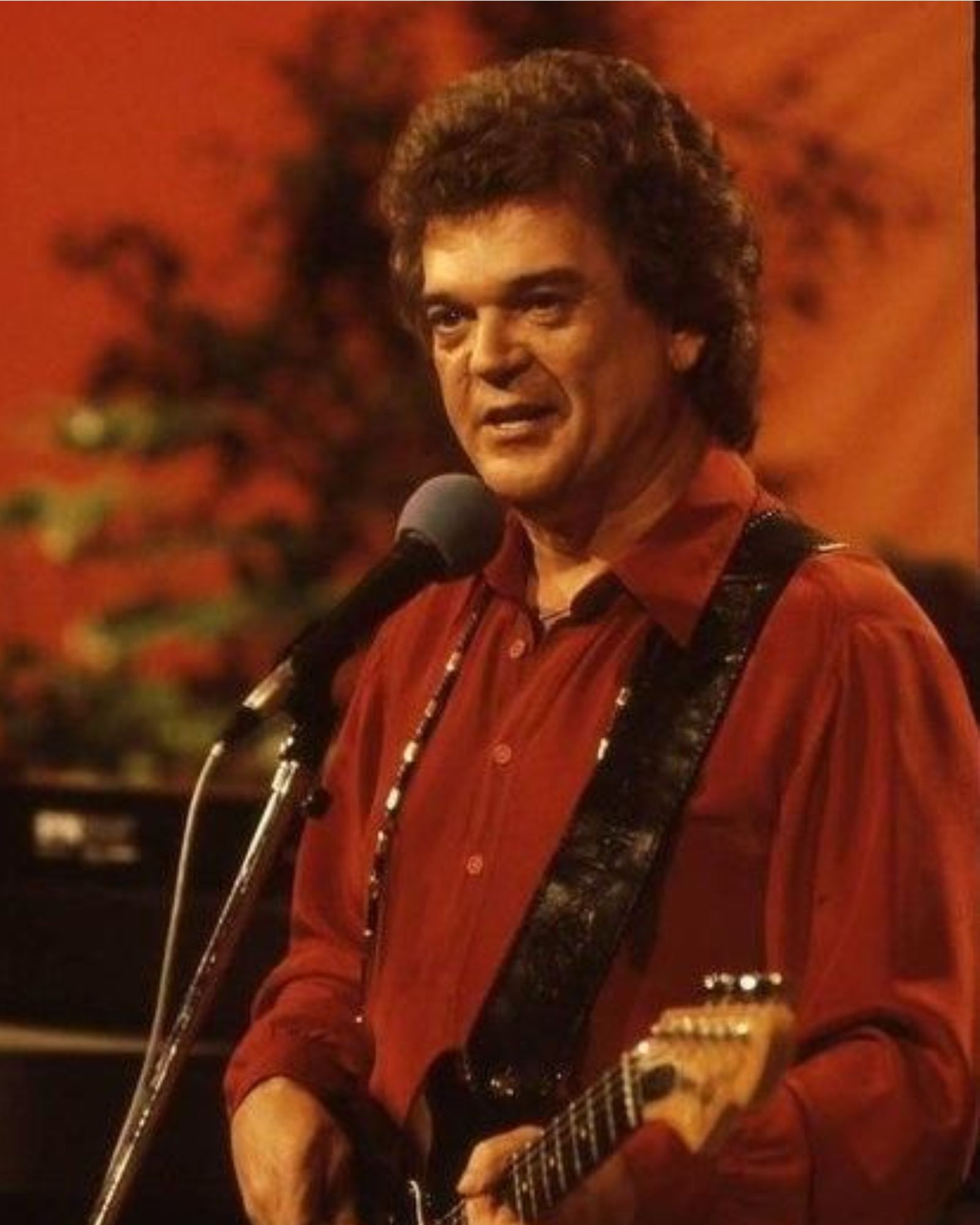
Conway Twitty was still recording new songs in May 1993. A few weeks later, he was gone.
Most farewell albums are assembled after the fact. Someone digs through the vaults, gathers unfinished takes, and builds a tribute. Final Touches was different. It was the record Conway Twitty was actively making in the last stretch of his life, and that is what gives it such quiet weight today.
A Night in Branson
On June 4, 1993, Conway Twitty played a show at the Jim Stafford Theatre in Branson, Missouri. He was 59 years old and still working the road the way he had for decades. Nashville’s big Fan Fair week was about to begin, and he was expected there.
After the show, he collapsed on his tour bus. He was rushed to a hospital in Springfield, Missouri, where he died the next day, June 5, from an abdominal aortic aneurysm.
The news hit country music hard. Conway Twitty was not a fading name from another era. He was a working star with a new album nearly ready to go.
The Record He Left Behind
Final Touches was recorded at the Sound Shop in Nashville between March 1992 and May 1993. The producer was Don Cook, one of the hottest names in Nashville at the time thanks to his work with Brooks & Dunn.
Conway Twitty was not just the voice on these sessions. He and his wife, Dee Henry, were credited as associate producers. That detail matters. This was not a label filling out a contract after a star’s death. It was a record shaped by Conway Twitty himself, made his way, right up to the final weeks.
MCA released Final Touches on August 31, 1993. It became his 58th and final solo album, or his 67th overall when the albums with Loretta Lynn are counted. It reached No. 29 on Billboard’s Top Country Albums chart and No. 135 on the Billboard 200.
The title track already carried the name “Final Touches.” Nobody planned for that name to become a goodbye, but that is exactly what it turned into.
The Ten Songs
The album runs just over 34 minutes. Here is the full track list with the songwriters:
1. “Two Timin’ Two Stepper” (Bobby Byrd, Kostas)
2. “I Hurt for You” (Deborah Allen, Rafe Van Hoy)
3. “Don’t It Make You Lonely” (Jackson Leap)
4. “I’m the Only Thing (I’ll Hold Against You)” (Joe Diffie, Kim Williams, Lonnie Wilson)
5. “I Don’t Love You” (Liz Hengber, Tommy Lee James)
6. “The Likes of Me” (Larry Boone, Rick Bowles)
7. “An Old Memory Like Me” (Don Cook, John Barlow Jarvis)
8. “Final Touches” (Gordon Bradberry, Tony Colton)
9. “You Are to Me” (Billy Livsey, Don Schlitz)
10. “You Ought to Try It Sometime” (Troy Seals, Eddie Setser, Billy Spencer)
It is a strong lineup of Nashville writers. Joe Diffie, a hitmaker in his own right, co-wrote one song. Don Schlitz, the man behind “The Gambler,” co-wrote another. Lonnie Wilson, who co-wrote “I’m the Only Thing (I’ll Hold Against You),” also played drums on the album.
“The Likes of Me”
Sitting at track six is “The Likes of Me,” written by Larry Boone and Rick Bowles. Play it today and you hear the same easy, unhurried baritone that carried “Hello Darlin'” decades earlier. There is no strain in it and no sense of a voice slipping. Conway Twitty sang it the way he sang everything, as if the woman listening was the only one in the room.
That was always his gift. Conway Twitty never needed to shout to fill a room. He leaned in close and let the song do the work.
The Song Kept Going
“The Likes of Me” did not end with Conway Twitty. In 1995, Don Cook produced a new version by Marty Stuart, who included it on his compilation The Marty Party Hit Pack. MCA released it as a single, and it reached No. 58 on the country chart.
It was not a big hit. But there is something fitting in it. A song Conway Twitty sang in his final sessions was picked up by another artist who has spent his career protecting country music’s history. The same producer guided both versions, two years apart.
Why Final Touches Still Matters
It is easy to romanticize a last album simply because of when it arrived. Final Touches deserves attention for a better reason. It shows Conway Twitty still at work, still choosing songs, still shaping his own sound with his wife beside him in the studio credits.
He did not get to promote it. He did not get to sing these songs on tour. But he finished what he started.
For a man who spent nearly four decades on the road, that may be the most Conway Twitty ending of all: the show in Branson was done, the record was done, and the voice was as warm as ever.