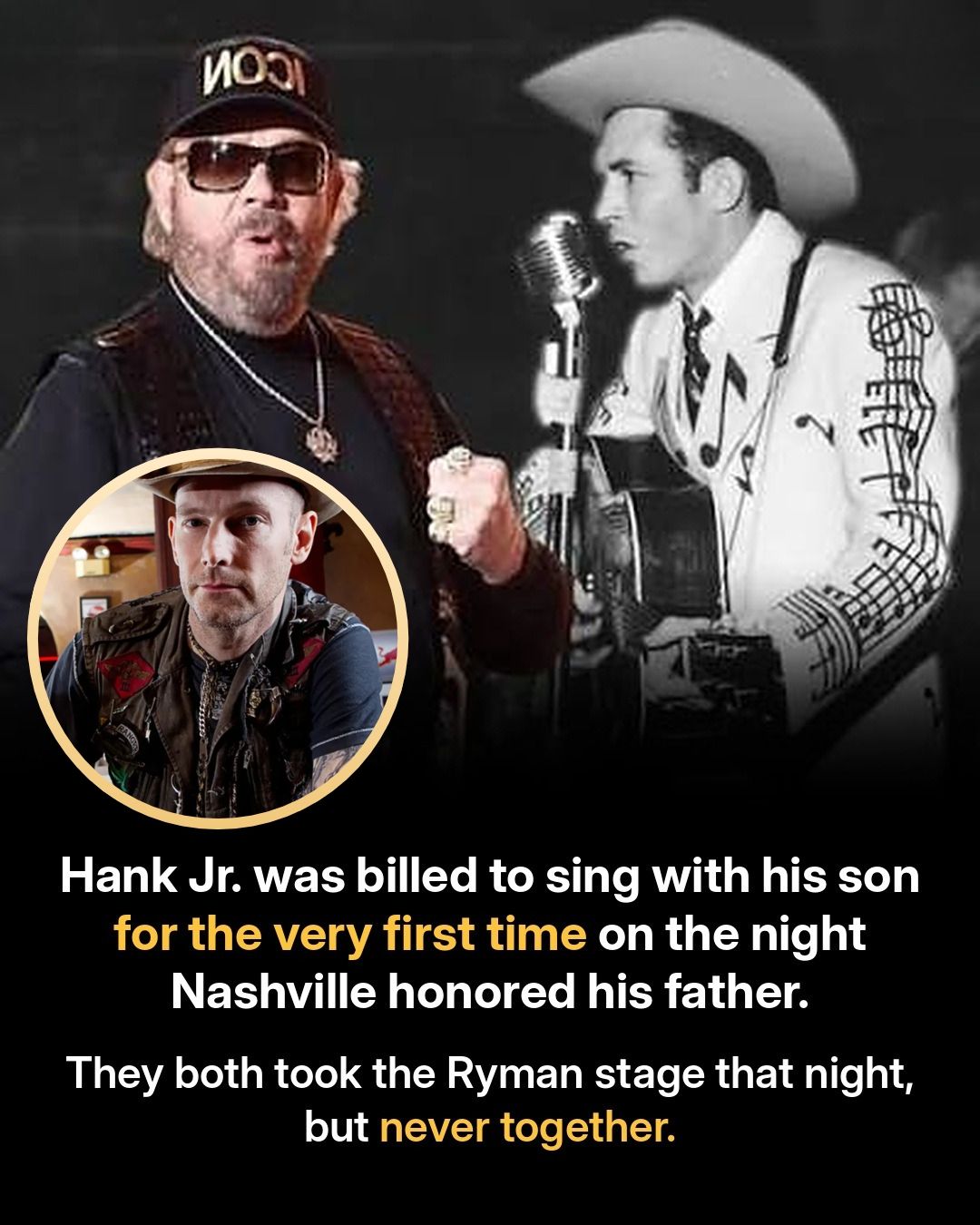
On January 4, 2003, the Grand Ole Opry gathered at the Ryman Auditorium to mark 50 years since Hank Williams died on New Year’s Day 1953. The night came with a promise announced weeks in advance: Hank Williams Jr. and his son, Hank Williams III, would perform together in public for the first time. Both men did take the stage that night. They just never took it together.
A Promise Made Weeks Before
When the tribute was announced in late November 2002, Hank Williams Jr. made it personal. He had already returned to the Opry earlier that year to honor Waylon Jennings, his first appearance there in many years, and this time the tribute was for his own father.
“This time I will be honoring my father and who better to be performing with but my own son, Shelton (Hank III).” — Hank Williams Jr., as quoted by Pollstar, November 2002
CMT reported it the same way, calling the January 4 show the first time father and son would ever perform onstage together. For fans who knew the family history, it sounded like a rare moment: the son and grandson of Hank Williams singing together on the very stage where his legend began.
The Stage Where Hank Sr. Had Once Ruled
The setting mattered. Hank Williams made his Opry debut on June 11, 1949, and was called back for six encores. Three years later, as his drinking caught up with him and he missed shows, the Opry let him go in 1952. He never played the Opry again. A few months later, on New Year’s Day 1953, he died at 29 on the way to a concert in Canton, Ohio.
Fifty years later, the Opry filled the same Ryman stage with his songs. The Whites played “Move It On Over,” Vince Gill sang “I’m So Lonesome I Could Cry,” and Little Jimmy Dickens did “Jambalaya.”
Two Hanks, Two Separate Moments
Hank Williams III came out on his own and played his grandfather’s “Howlin’ at the Moon,” a performance Rolling Stone later praised for its hillbilly energy. Then he used the moment to ask for something on his grandfather’s behalf. According to Saving Country Music’s account, he told the crowd:
“After all this time, maybe it’s time we can get Hank Williams back, reinstated in the Grand Ole Opry.”
He followed it with “Thrown Out of the Bar,” a honky-tonk song that would not appear on record until his 2006 album Straight to Hell.
Hank Williams Jr. had his own set. He sang “Kaw-Liga” and other classics from his father’s catalog, and he joined Little Jimmy Dickens, Vince Gill and the Whites to sing “I Saw the Light.” The father and son who had been promised as a pair never appeared in the same song.
The Man in the Wheelchair
Another part of Hank Williams Jr.’s set reached back further than his own family. He used part of the night to honor Rufus “Tee-Tot” Payne, a Black street musician from Alabama who, by Hank Jr.’s account, taught his father to play guitar and sing the blues. Hank Sr. himself told a Montgomery reporter in 1951 that all the music training he ever had came from Tee-Tot.
Years before the tribute, Hank Williams Jr. had hired Alabama librarian and historian Alice Harp to find Tee-Tot’s grave. She found it in Montgomery’s Lincoln Cemetery, where a marker now stands.
On the Opry stage that night, Tee-Tot’s son, Henderson Payne, then in his 80s, joined Hank Jr. in a wheelchair. Decades after a boy named Hank followed a street singer around an Alabama town, the son of each man stood under the same Ryman lights.
What Was Never Explained
Why Hank Williams Jr. and Hank Williams III did not perform together that night has never been confirmed. The Associated Press, reporting on the show afterward, said only that the joint performance promised by promoters never happened, and that the two men, by many accounts, had a strained relationship.
That strain had deep roots. Hank Williams III was raised largely apart from his famous father, who lived with him only until he was about four years old, according to a later profile in Cleveland Scene. No explanation from either man appeared in the reporting on that night, and any reason offered today would be a guess.
What That Night Started
The words Hank Williams III spoke from the Ryman stage did not end there. Soon after the show, he took his request to Opry management. By his account, he was told, “We’ll never reinstate a dead guy.” An online petition followed in February 2003, and the campaign became known as Reinstate Hank.
More than two decades later, the Opry has still not reinstated Hank Williams. When it honored him again at the Ryman in January 2026, his grandchildren Holly, Hilary and Sam Williams sang his songs. Hank Williams III, who has not performed in public since 2014, was not on the bill.