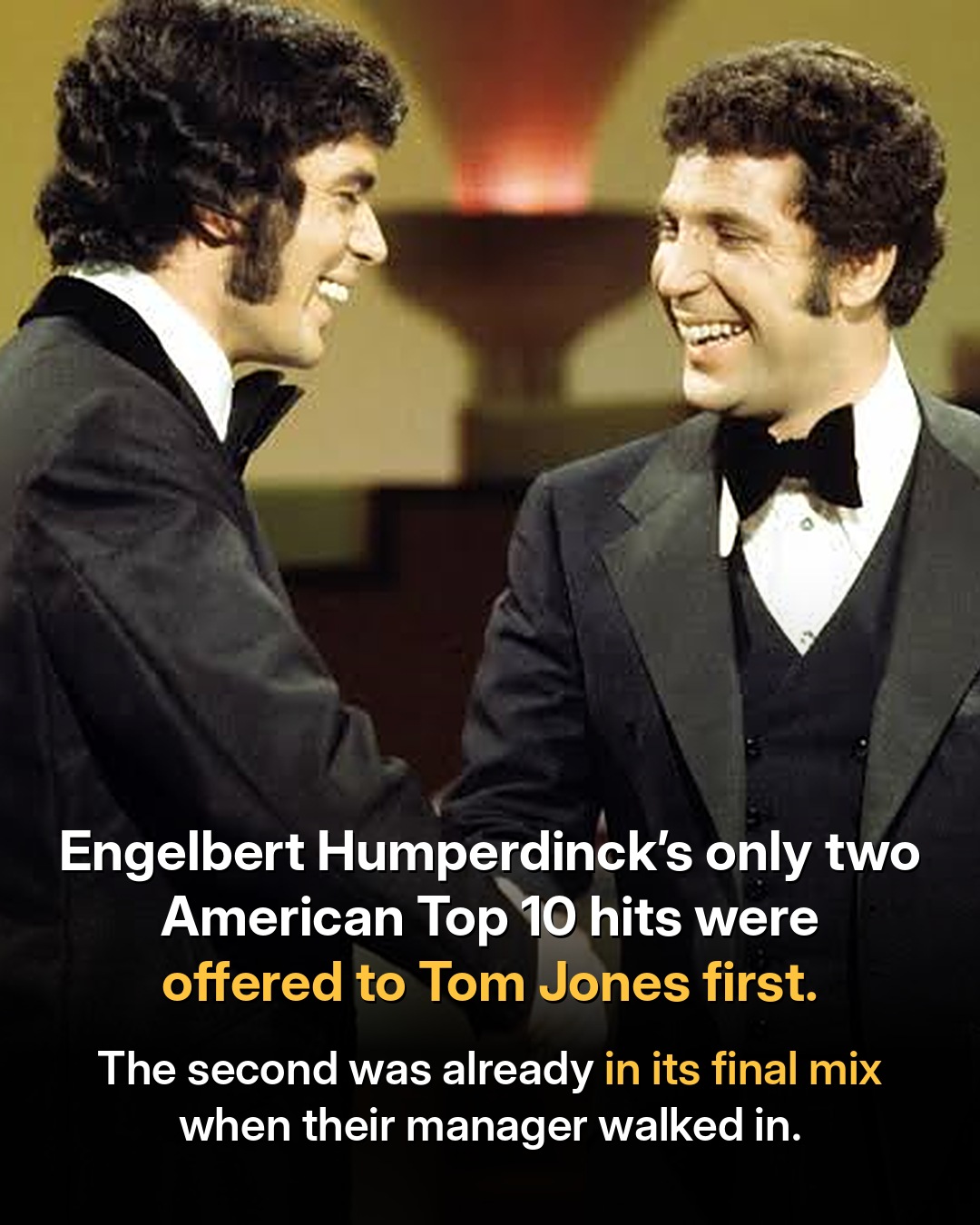
The song was “After the Lovin’.” In 1976 it gave Engelbert Humperdinck a gold record, two weeks at No. 1 on Billboard’s Easy Listening chart and a No. 8 peak on the Hot 100. It was the second and last time he ever reached the American Top 10. And it very nearly went to Tom Jones instead.
The Day in the Mixing Room
Engelbert had just moved to Epic Records, and the new album was in the hands of producers Joel Diamond and Charlie Calello. The song itself was not brand new. Songwriters Ritchie Adams and Alan Bernstein had written it in 1974, Adams had cut a demo, and singers Rick Chambers and Jack Jones had both recorded it in 1975 without turning it into a hit.
Joel Diamond has told the story of what happened next. He and Calello were in the studio finishing the final mix of Engelbert’s recording when Gordon Mills walked in. Mills was the most powerful man in Engelbert’s career. He had renamed Gerry Dorsey as Engelbert Humperdinck in 1965, and he also managed Tom Jones and Gilbert O’Sullivan. According to Diamond, Mills came in and gave his verdict on the spot:
“This song was not for Engelbert but would work better for his other client, Tom Jones.”
Weeks went by. Then Mills called back. Tom Jones did not like the song, Diamond recalled, and Engelbert could have it for his new album after all.
It Had Happened Before
Engelbert later told Diamond that Gordon Mills had done the exact same thing with “Release Me,” the 1967 record that made him a star. That story has its own witness. Arranger Charles Blackwell recalled recording “Release Me” with Tom Jones a week before he recorded it with Engelbert. Tom’s version had a gospel feel, and it never came out. Engelbert has said Mills suggested the song to Tom first, Tom didn’t like it, and Mills told him, “You can have it.”
“Release Me” went to No. 4 on the Billboard Hot 100. Nearly ten years later, the song Mills wanted for Tom went to No. 8. Those were Engelbert Humperdinck’s only two American Top 10 hits.
Engelbert never hid how this kind of thing felt. He has said Mills did not show the same care for his career as he did for Tom’s, and that he eventually went off on his own because “Gordon was partial to him.” Engelbert has also tied his long rift with Tom Jones to that decision to leave Mills.
The Stations That Wouldn’t Play It
Keeping the song was only half the fight. By Joel Diamond’s own account, nothing on American radio in 1976 sounded like “After the Lovin’,” and he knew the big Top 40 stations would not touch it. So for weeks and months he worked the phones himself, calling small secondary stations one by one and talking a few of them into giving it a spin.
One of those stations was a middle-of-the-road outlet in Buffalo, New York, where the program director already loved Engelbert. A promotion man named Jerry Myers, whom Diamond did not even know at the time, heard the record there while driving home from work.
The next morning, Myers called local record stores. Customers, they told him, were already asking for it. Myers then walked into WKBW, Buffalo’s powerful 50,000-watt Top 40 station, and in Diamond’s telling, he did not ask whether they would play it. He asked when.
WKBW added the record, and Diamond said the phones lit up. From Buffalo it moved to Boston, then New York and Miami, and the big Top 40 stations around the country followed.
What It Became
“After the Lovin'” was released in October 1976 and climbed to No. 8 on the Billboard Hot 100 and No. 5 on Cash Box. It spent two weeks at No. 1 on the Easy Listening chart, topped the charts in New Zealand and the Adult Contemporary list in Canada, and was certified gold. The album earned Engelbert a Grammy nomination for Best Pop Vocal Performance, Male. Oddly, it never charted in his home country of England.
It also reached No. 40 on Billboard’s country chart, his first visit to the country Top 40. Country fans heard it again soon after, when Barbara Mandrell recorded it for her 1977 album Lovers, Friends and Strangers. Her version earned her a Grammy nomination for Best Country Vocal Performance, Female.
Joel Diamond has called it the biggest hit Engelbert ever had in the United States. On the Hot 100, “Release Me” peaked higher. But “After the Lovin'” was Engelbert’s last trip to the American Top 40, and it was the start of a partnership with Diamond that would go on to produce “This Moment in Time” and many more recordings.
Still in the Show
Engelbert Humperdinck turned 90 in May 2026, and he is still touring. On his Celebration Tour this year, from New Zealand and Australia to Canada, “After the Lovin'” has stayed in the set from show to show.
The song his manager once wanted for someone else has followed people through their lives. In 2023, Engelbert said he still hears what it meant to his fans, and shared what one of them had just told him:
“We got married to After the Lovin’.”