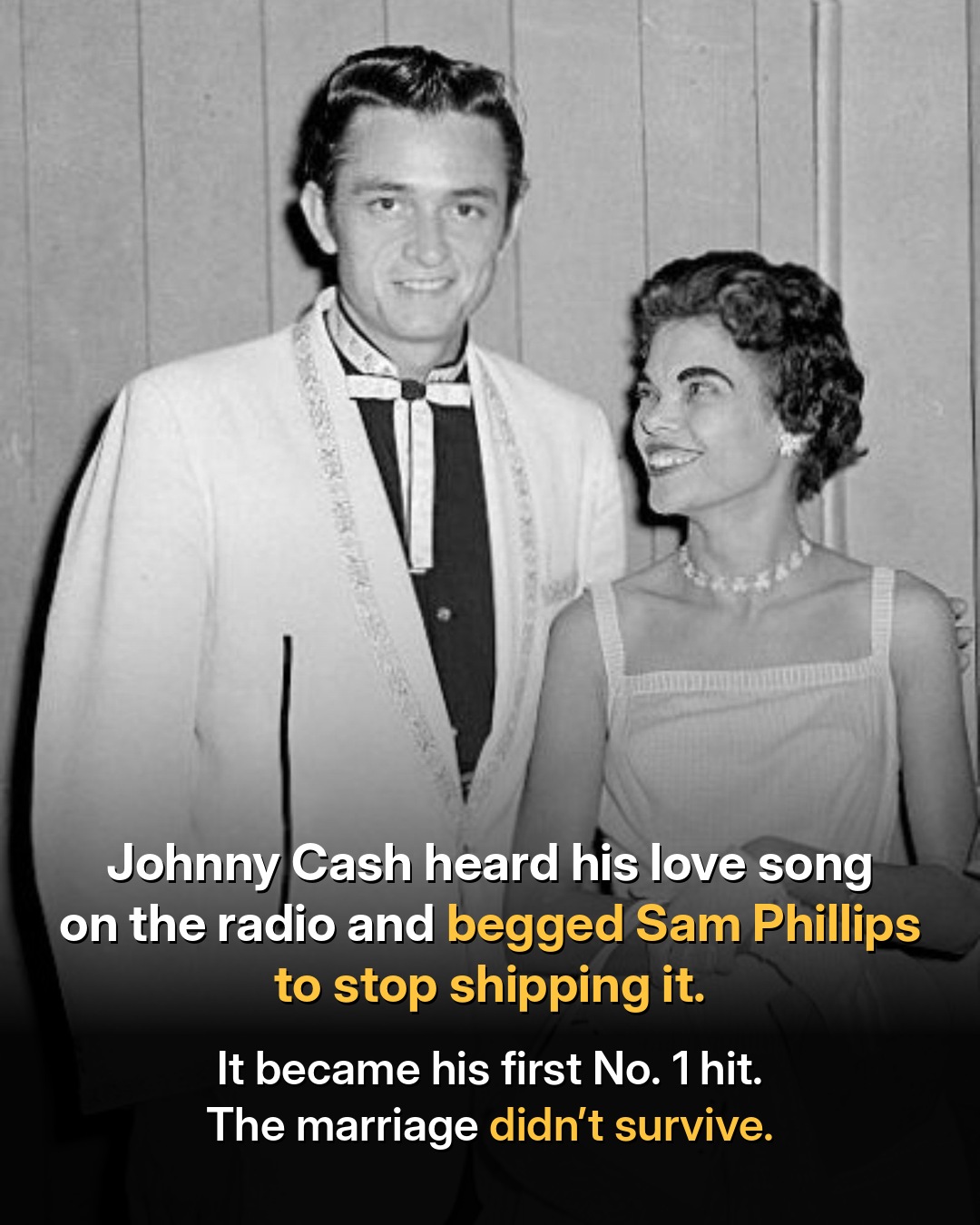
The answer is “I Walk the Line”, written and recorded by Johnny Cash in 1956. It became his first No. 1 country hit and one of the best-known songs in American music. It started as something much smaller: a young husband’s promise to the wife waiting for him at home.
A Newlywed on the Road
Johnny Cash married Vivian Liberto in San Antonio on August 7, 1954, a month after he left the United States Air Force. They had met before he was stationed in Germany. During his years overseas the two wrote each other a huge number of letters, and those letters kept the relationship alive across an ocean.
By 1956 Johnny Cash was signed to Sun Records in Memphis. He was a new father and was spending more and more time on tour with the label’s rising stars, including Elvis Presley, who drew crowds of excited fans wherever he played. Life on the road was full of temptation, and Johnny Cash knew it.
“I suppose I was laying out my pledge of devotion.”
That is how Johnny Cash later described the song. In another interview he called it a reminder to himself to “Play it straight, Johnny.” It was a vow of fidelity to Vivian Liberto, and it was also a warning he was writing to himself.
Where Exactly Was It Written?
Johnny Cash told this part of the story in more than one way. In his first autobiography he said he wrote the song in 1955 before a show in Shreveport, Louisiana. In a later autobiography he placed it backstage in Gladewater, Texas, in 1956. In that version, fellow Sun artist Carl Perkins heard the phrase and told him it would make a great title, and Johnny Cash finished the song in about twenty minutes. His bassist, Marshall Grant, remembered it differently. He said it began when Johnny Cash hummed along to some slow bass runs before a show in Longview, Texas.
The details differ from one account to the next, but the purpose of the song stays the same in all of them.
A Sound Born From a Backwards Tape
The unusual chord changes go back to Germany. Johnny Cash recalled that his Air Force friends had borrowed his reel-to-reel tape recorder. When he got it back, a recording of his band, the Landsberg Barbarians, played in reverse. He wrote that the result “sounded like spooky church music,” and the eerie, droning sound stayed in his head for years.
The finished song changes key between verses. Before each new verse, Johnny Cash hums a note to find his pitch. Later, on his television show, he told the audience with a smile that the humming was simply how he found the next note.
The Record He Tried to Stop
Johnny Cash recorded the song at Sun Studio on April 2, 1956. He imagined it as a slow, solemn ballad, but Sam Phillips wanted it faster. To get a snare-like rattle, Johnny Cash slipped a piece of paper between his guitar strings.
The single came out on May 1, 1956. Johnny Cash later said that when he heard the faster version on the radio, he did not like it. He called Sam Phillips and asked him to stop sending out copies. Sam Phillips told him to give it a chance, and within days, by Johnny Cash’s own account, the record took off.
A Promise Kept in Ink
“I Walk the Line” reached No. 1 on the country chart and No. 17 on the pop chart. It was Johnny Cash’s first big crossover hit and the song that made him a star.
The marriage it was written to protect did not last. Johnny Cash and Vivian Liberto divorced in the 1960s, and Johnny Cash later married June Carter. Vivian Liberto raised their four daughters, Rosanne, Kathy, Cindy and Tara, and kept the love letters from those early years.
Vivian Liberto died in 2005. Two years later her memoir was published, built around those letters, and its title was I Walked the Line. Her title echoes the promise Johnny Cash made to her in the song, written in the past tense.
Why the Song Still Matters
Johnny Cash recorded “I Walk the Line” again several times over his career and sang it on stage for decades. It is still the song many people think of first when they hear his name. The words began as one young husband’s private promise to Vivian Liberto, and millions of listeners have since sung along to them.