On the morning of July 3, 2001, the Ryman Auditorium in Nashville was full, but the most important thing on its stage was standing still. An orange electric guitar rested on a stand. Beside it sat a white fedora. About fifty floral arrangements curved around them in a semicircle.
The guitar belonged to Chet Atkins. He had died four days earlier, on June 30, at the age of 77. His friends knew a eulogy alone would not be enough. Chet Atkins had always spoken through his guitar, so the farewell would have to be played too.
A Room That Remembered Him
The Ryman was more than a convenient place for a funeral. Chet Atkins’ casket rested on the floor near the wooden pews where country fans had first heard him on the Grand Ole Opry in 1946, when he was a young guitarist in Red Foley’s band. Fifty-five years later, family and friends filled the lower pews. Fans of several generations crowded into the balcony above them.
The service lasted about fifty minutes. Connie Smith and Marty Stuart opened it with the old hymn “Farther Along.” Eddy Arnold, whose records Chet Atkins had produced, rose to speak. Garrison Keillor gave the eulogy. Much of it came from letters Chet Atkins had sent him, and they were funny, honest and full of a dry wit that many people in the room knew well.
Then it was time for the guitars.
Three Friends and One Familiar Melody
Steve Wariner, Vince Gill and Paul Yandell came to the stage, with David Hungate on bass. Together they played a medley in the thumb-and-finger picking style that Chet Atkins had made famous around the world.
Paul Yandell had the closest connection of all. From 1975 until the late 1990s he had played next to Chet Atkins on concert stages, in recording studios and on television.
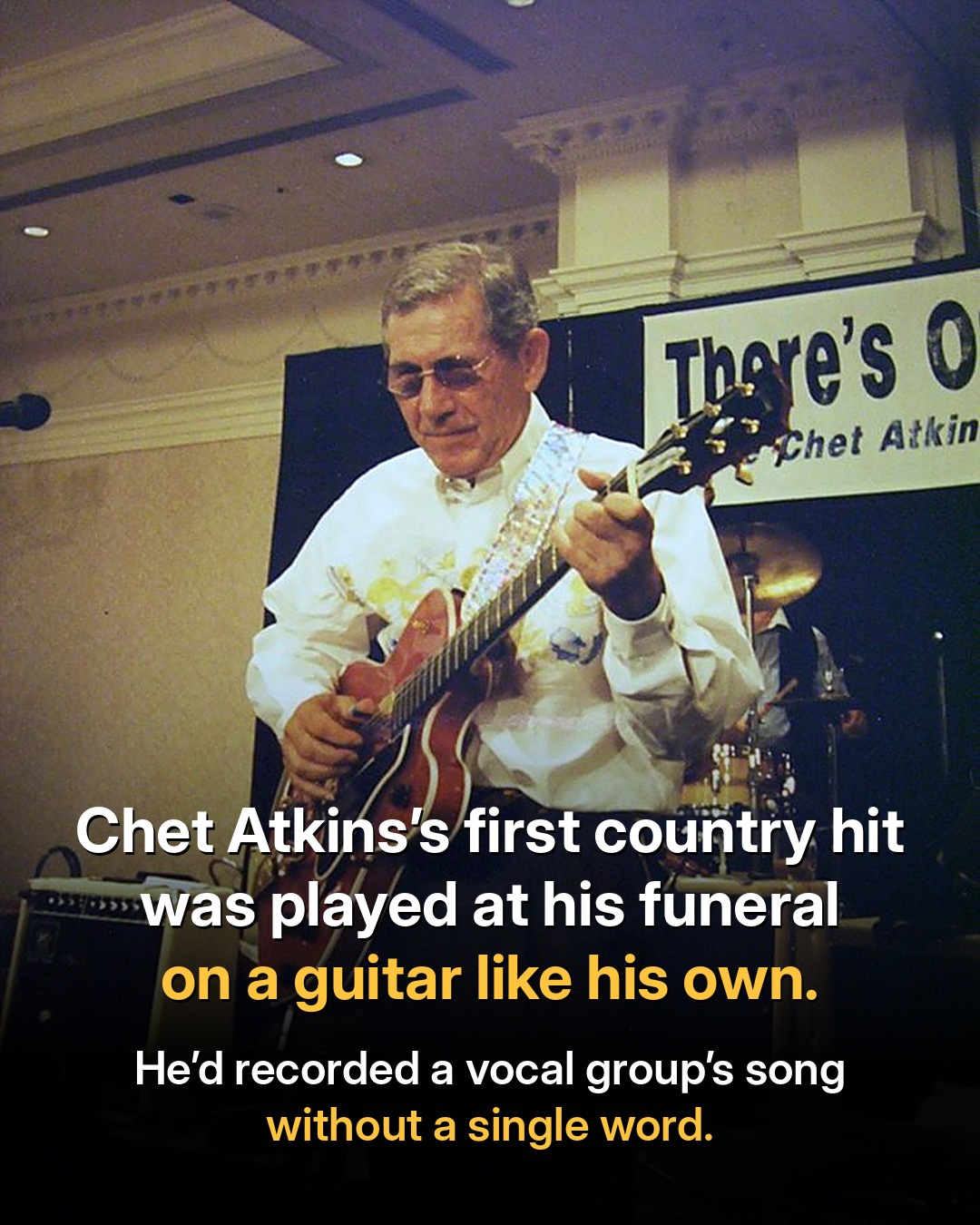
That morning he played one particular tune on a guitar like the one standing silent on the stand.
The Song Was “Mr. Sandman”
“Mr. Sandman” was not originally a Chet Atkins song. Pat Ballard wrote it, and The Chordettes made it one of the biggest vocal hits of 1954. In their version a young woman asks the mysterious visitor who brings the night to deliver the perfect sweetheart, and she describes exactly the kind of man she has in mind.
Chet Atkins heard something else in it. He recorded his own version with no singing at all, letting his guitar carry the bouncing melody and the playful harmonies on its own. The single came out in January 1955, and it became his first record to reach Billboard’s country chart.
The tune that first put Chet Atkins’ name on a country chart was played a few steps from where he first stood on the Opry stage.
Why That Moment Still Matters
No one explained publicly why the tune was included, and nobody needed to. It connected the beginning of the story to its end. On the day he was laid to rest, the music sounded as light and cheerful as it had in 1955.
Chet Atkins was once asked how he wanted to be remembered. He said he hoped people would say he played in tune, played in good taste and was nice to people. In that room, his friends answered for him without saying a word, simply by playing his music the way he had taught them to love it.
The service ended with words Chet Atkins had written about how much he still loved holding his guitar. Vince Gill, Steve Wariner, Paul Yandell and Ray Stevens were among the pallbearers who carried him out. He was buried that afternoon at Harpeth Hills Memory Gardens.
The orange guitar on the stage never made a sound that day. It did not need to, because the people who loved Chet Atkins played for it.
What song would you want played to say goodbye to you?