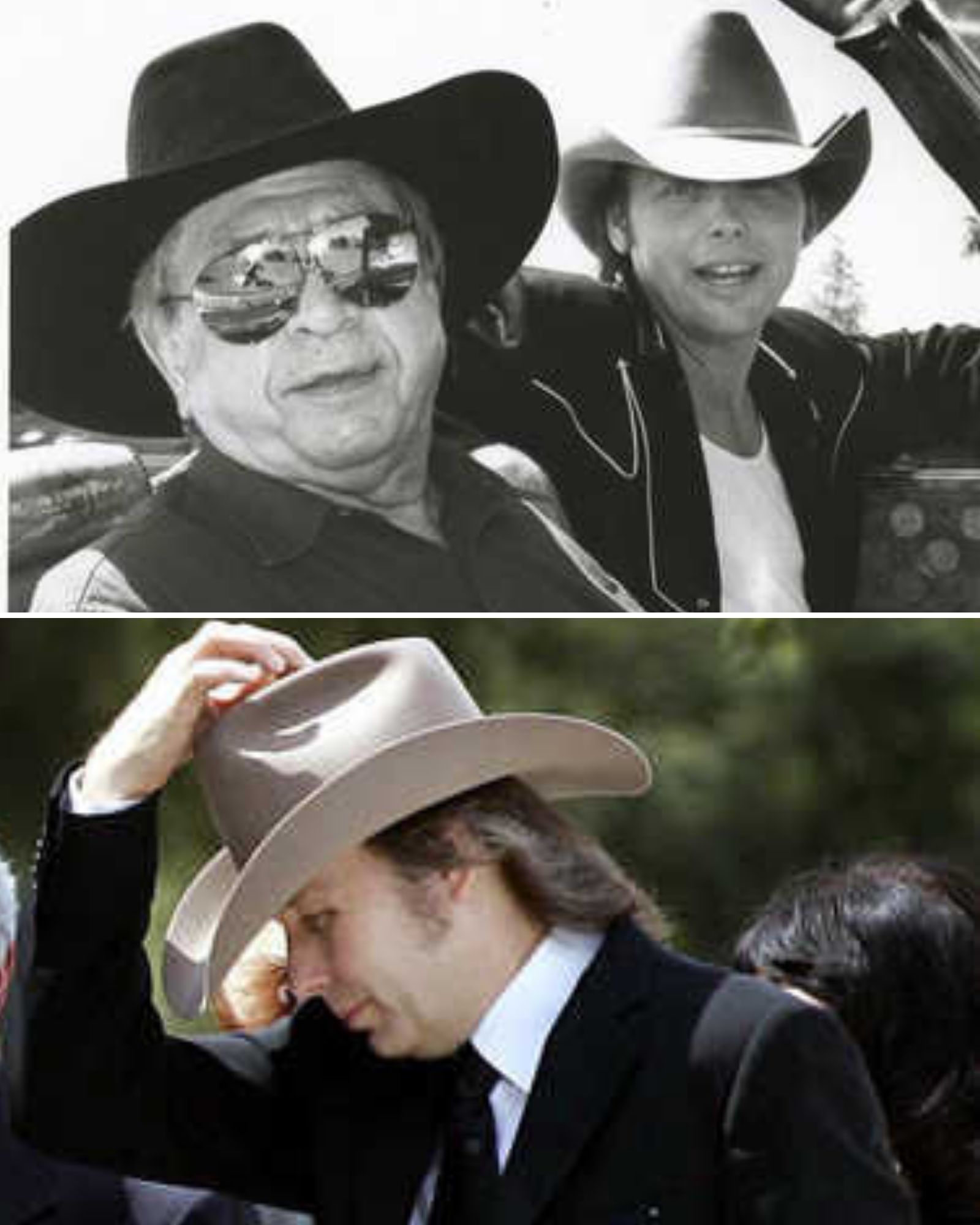
The hymn was “In the Garden,” the old church standard many Americans know by its opening words about coming to the garden alone while the dew is still on the roses. When Dwight Yoakam sang it at Buck Owens’ funeral in April 2006, it sounded like a fitting church farewell. But the choice was personal. Buck loved that hymn, and he and Dwight had talked about it.
Dwight confirmed it himself ten years later, on public radio, with a guitar in his hands.
A Sunday in Bakersfield
Buck Owens died at his home in Bakersfield on March 25, 2006, at 76, just hours after his final appearance at his own Crystal Palace. The day before the funeral, more than 6,000 people filed past his open casket, set among flowers on the Crystal Palace dance floor.
On Sunday, April 2, more than 2,000 family members, friends and fans filled Valley Baptist Church. Inside, flowers were arranged in the shape of Buck’s trademark red, white and blue guitar. Outside, a huge American flag hung from a fire rescue ladder above the church. Some mourners came in black suits. Others came in cowboy hats, boots and big belt buckles.
Garth Brooks was there. So were Trace Adkins and Brad Paisley. Radio programmer RJ Curtis, who once worked for a station Buck owned, later described the service as feeling more like a celebration than a day of mourning.
“Buck Always Told Him He Looked Good in a Hat”
When it was Dwight Yoakam’s turn, he was very emotional, according to Curtis’s account in the trade paper Radio & Records. He apologized to the congregation for singing with his hat on in church. Then he gave the reason: Buck had always told him he looked good in a hat.
Then he sang “In the Garden.” Curtis called the performance riveting.
What Dwight Told Terry Gross
For years, the hymn could have looked like a simple, safe choice for a church funeral. Dwight explained otherwise in December 2016, when he appeared with Terry Gross on NPR’s Fresh Air to promote his bluegrass album Swimmin’ Pools, Movie Stars…
Gross asked him about the singing in the church he grew up in, the Church of Christ. Dwight described a congregation that sang without instruments, all a cappella, and said those old hymns had shaped the way he wrote songs for the rest of his life.
Then she asked if he would sing one.
He answered by telling her he had sung this one at Buck’s funeral, and why:
“It was one of his favorite hymns.”
He added that he and Buck had talked about it one time. As Dwight told it, the subject came up with Buck after he had sung “In the Garden” for a program about the life of Minnie Pearl. She had once told him it was her favorite hymn as well.
Then Dwight played a few lines of it on his guitar, right there in the studio. A decade after the funeral, asked for any hymn at all, it was the one he chose.
Two Friends, One Song Between Them
The story makes more sense when you remember what these two men meant to each other. In 1987, Dwight met his hero at the Kern County Fair and coaxed him back onstage after years of semi-retirement. The next year, their duet “Streets of Bakersfield” went to No. 1. It was Buck’s first chart-topper in 16 years and the first No. 1 of Dwight’s career.
The friendship stuck. Dwight later recalled that Buck would phone him and announce himself with his full name and calling himself “your old buddy Buck.”
So when it came time to choose one song to sing over his friend, Dwight didn’t reach for a hit. He reached for something Buck had once told him he loved.
After the Hymn
When Dwight finished, a recording of Buck himself was played: his version of “Dust on Mother’s Bible.” Brad Paisley followed with “When I Get Where I’m Going.” Later that day, family and friends gathered back at the Crystal Palace, where Buck’s son Buddy, Paisley and Dwight sang again.
The next year, Dwight released Dwight Sings Buck, a full album of Buck Owens songs. But the song he sang for Buck that Sunday was not on it. It was an old hymn, sung in a Bakersfield church with his hat on, because his friend always said he looked good in it.
Is there a hymn that always takes you back to someone you loved?