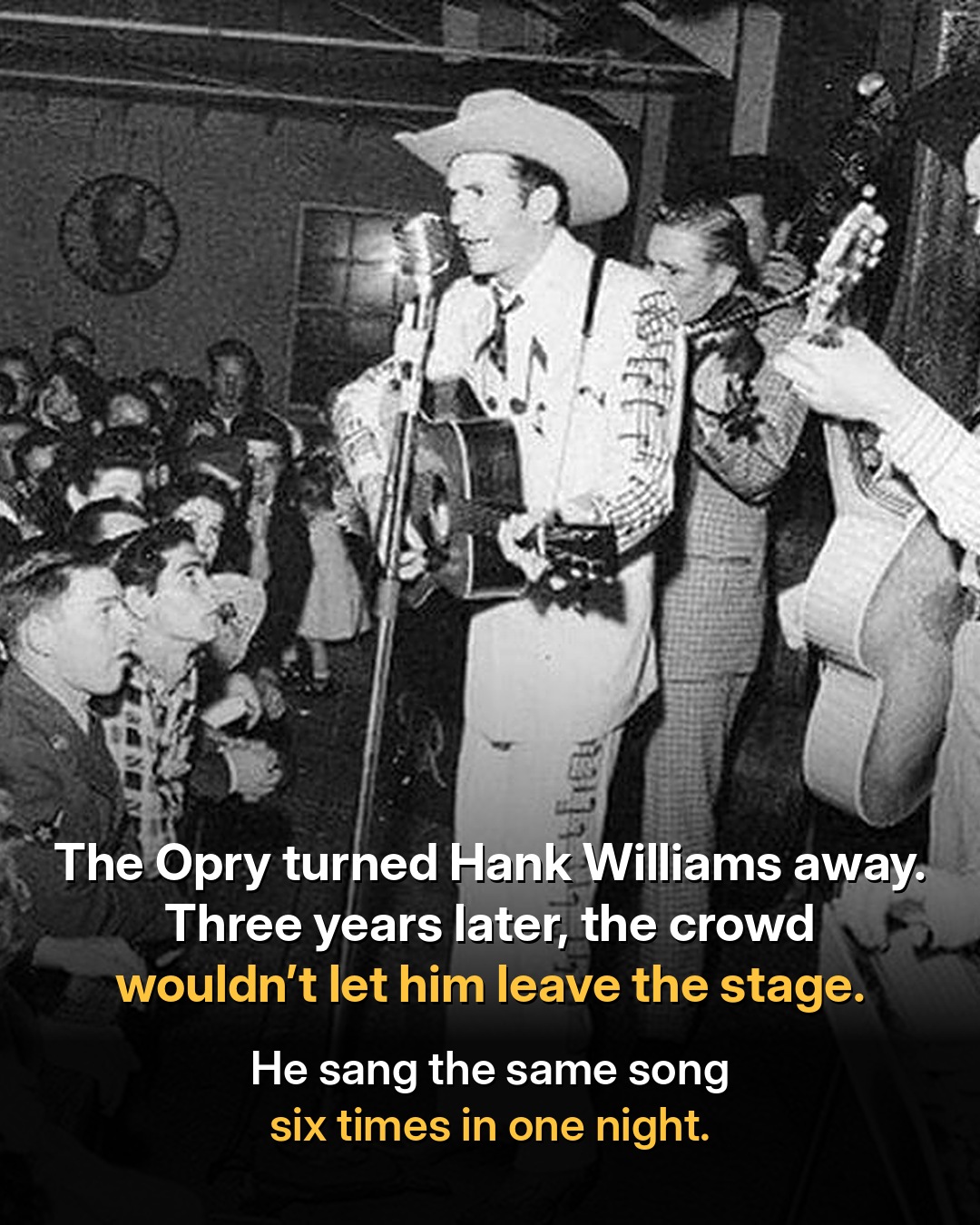
The song Hank Williams sang six times on the night of June 11, 1949, was “Lovesick Blues.” It was an old show tune that Hank Williams did not write and that his own producer did not want him to record. It became the song that broke open the doors of country music’s most famous stage.
Turned Away in 1946
Before that night, the Grand Ole Opry had already said no to Hank Williams. In 1946, encouraged by his friend and hero Ernest Tubb, the young singer from Alabama auditioned for the Opry and was rejected. Hank Williams was talented, but he also had a drinking reputation that made Nashville’s gatekeepers nervous.
Instead of giving up, Hank Williams signed a songwriting deal with Acuff-Rose Music and went to Shreveport, where he joined the Louisiana Hayride. Across a wide stretch of the South, radio listeners began to learn his name.
A Song From 1922
“Lovesick Blues” was already more than twenty years old by then. Cliff Friend and Irving Mills wrote it for a 1922 musical called Oh, Ernest, and several performers recorded it in the decades that followed. Hank Williams had learned it from earlier versions and started using it on the Louisiana Hayride, where audiences loved the way he bent and yodeled through the melody.
When it came time to record it, Fred Rose, his producer and mentor, was not convinced, and the band was not enthusiastic either. Hank Williams pushed for it anyway. In December 1948, during a session in Cincinnati, he cut “Lovesick Blues” in the last half hour of studio time, almost as an afterthought.
The Afterthought That Took Over
Released in early 1949, “Lovesick Blues” exploded. It climbed to No. 1 on the country charts and stayed there for 16 weeks. That success made Hank Williams impossible to ignore, even for the Opry managers who had once sent him away.
June 11, 1949: The Ryman Auditorium
So, at 25 years old, Hank Williams walked onto the stage of Nashville’s Ryman Auditorium for his Grand Ole Opry debut. Accounts say he and his band performed “Lovesick Blues” and “Mind Your Own Business.”
When Hank Williams finished, the crowd would not stop cheering. He came back and sang “Lovesick Blues” again. Then the applause rose once more, and he came back again. It kept going until Hank Williams had answered six encores, something widely remembered as a first in the show’s history. The audience finally had to be persuaded to let the rest of the program go on.
The singer the Opry had turned down three years earlier had just delivered one of the most famous debuts it would ever see. Hank Williams joined the cast and became one of its brightest stars.
The Fall
The triumph did not last. Over the next three years, Hank Williams wrote and recorded songs that would define country music, but his personal struggles grew harder to hide. Missed shows piled up, and in August 1952 the Grand Ole Opry fired him.
Only months later, on January 1, 1953, Hank Williams died at the age of 29. For most of his final years, “Lovesick Blues” had been the song he used to close his shows.
Why “Lovesick Blues” Still Matters
Decades later, the recording is still honored. In 2004, the Library of Congress added it to the National Recording Registry, and in 2011 it was inducted into the Grammy Hall of Fame.
Today, the story still feels remarkable because of how unlikely it was. It is an old song that nobody else in the room believed in. It was recorded in a rushed final half hour by a singer the Opry had already rejected. And on one June night in Nashville, that same singer heard a packed hall call him back again and again, six times, for a song he never wrote but made completely his own.
The Legacy of One Night
Hank Williams had a short career, but that debut became part of country music legend. Whenever people talk about the greatest nights at the Grand Ole Opry, they still come back to June 11, 1949, and to “Lovesick Blues.”