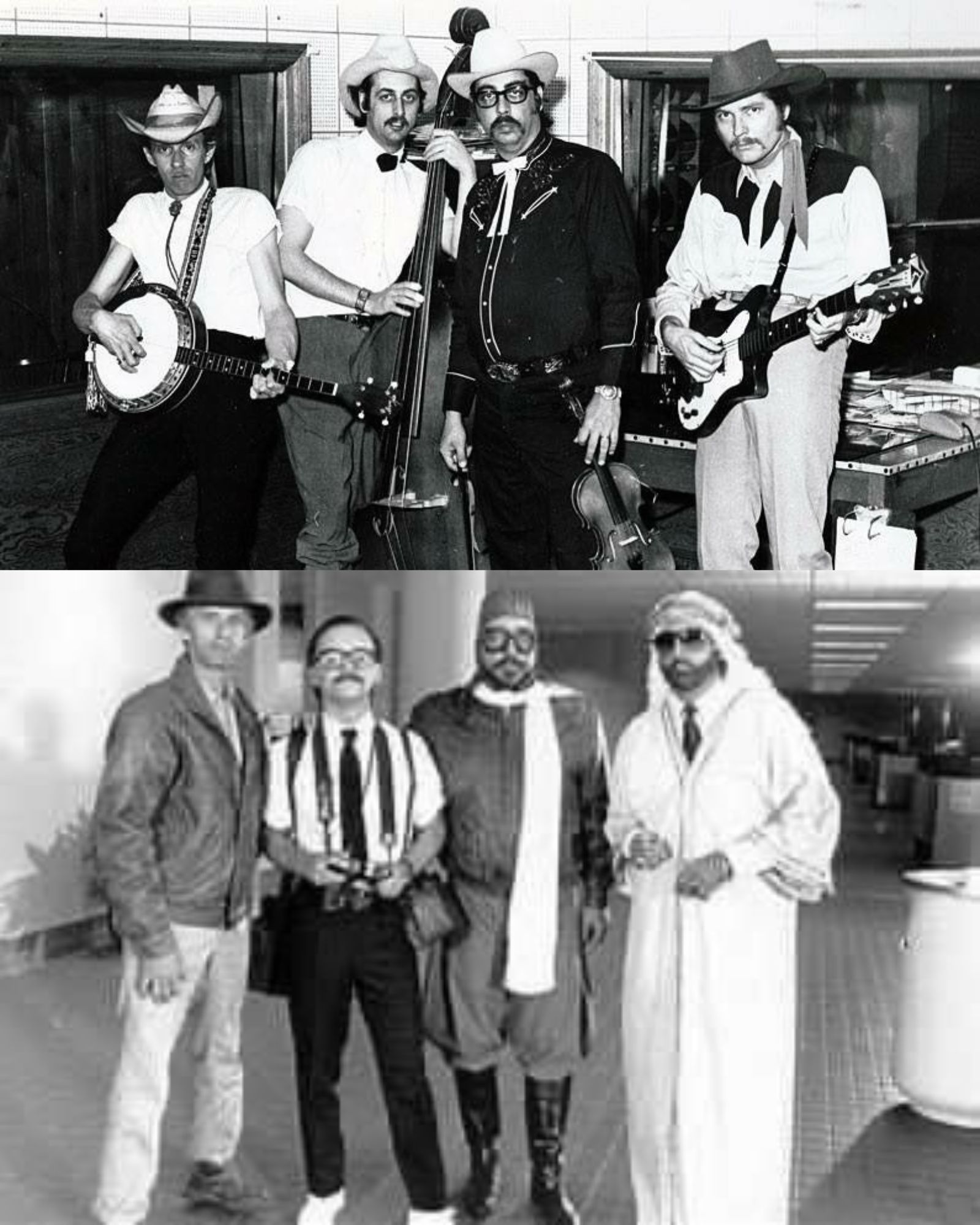
The Statler Brothers were famous for getting their harmonies just right. But in the early 1970s, Harold Reid, Don Reid, Phil Balsley, and Lew DeWitt took on a recording project that required something entirely different: they had to make themselves sound like musicians who could barely play.
And according to their longtime producer, Jerry Kennedy, doing it badly actually took considerable talent.
It Started With a Fictional Country Band
In 1972, The Statler Brothers released Country Music Then and Now, an album that included a comedy segment called “Saturday Morning Radio Show.”
The segment introduced Lester “Roadhog” Moran and His Cadillac Cowboys, a fictional country band from a place called Rainbow Valley.
Lester and his musicians were supposed to represent the kind of struggling local performers who once appeared on small-town radio programs. They had plenty of confidence, even if their musical abilities didn’t justify it.
The characters allowed The Statler Brothers to poke affectionate fun at an older era of country entertainment. Instead of mocking the music itself, the comedy came from the awkward performances, exaggerated personalities, and familiar conventions of old-fashioned radio shows.
The idea proved popular enough to become a recording project of its own.
The Recording Session Where Playing Badly Was the Goal
In 1974, Mercury Records released Lester “Roadhog” Moran and His Cadillac Cowboys: Alive at the Johnny Mack Brown High School.
Despite its title, this was not a documentary recording of an actual school concert. It was a carefully constructed comedy performance, written and performed by The Statler Brothers.
The imaginary concert featured recognizable country songs, including “Sixteen Tons,” “Filipino Baby,” and “Wildwood Flower.” But the performances were deliberately rough.
Instruments sounded out of tune. Singers struggled to stay together. Musical timing seemed almost nonexistent. Songs moved along with the uncertainty of a band that had never quite mastered its material.
Even the fictional musicians had their own personalities. One character, Wichita, was supposed to deliver a guitar solo during the imaginary show but was conspicuously absent when his moment arrived.
It was precisely the sort of detail that made the recording work. The Statlers weren’t simply singing badly. They were creating an entire fictional musical world.
Jerry Kennedy Remembered Lew DeWitt’s Guitar Playing
Jerry Kennedy, the respected Nashville producer who worked extensively with The Statler Brothers, later recalled the unusual project in an interview with Vintage Guitar magazine.
Kennedy specifically remembered Lew DeWitt playing guitar on the comedy recordings.
According to Kennedy, the guitar sounded awful, but that was part of the accomplishment. Kennedy also marveled at the group’s ability to sing convincingly out of tune.
For a quartet whose professional reputation depended on carefully arranged harmonies, deliberately abandoning those skills was an unusual challenge.
Kennedy remembered the album with affection, even joking that everyone involved had spent years trying to live the project down.
He also recalled being told that copies of the record could be found on tour buses leaving Nashville after its release. The story suggests how well the humor connected with people who understood the country music business from the inside.
A Fake Radio Show That Fans Remembered
The album went beyond its imaginary high school concert. It also included a fictional Saturday morning radio broadcast and a supposedly confidential audition tape from Rainbow Valley.
These segments expanded the personalities of Lester Moran and the Cadillac Cowboys. The fictional group wasn’t aware of its shortcomings. In its own imaginary world, it was a perfectly respectable country band.
That confidence was central to the joke.
For listeners familiar with old country radio programs, the format was recognizable. The announcements, musical selections, and exaggerated amateur performances recalled an earlier broadcasting tradition.
The characters continued to attract interest long after the original release. In 1995, a collection titled The Complete Lester “Roadhog” Moran and the Cadillac Cowboys brought the comedy recordings together with additional material.
The Joke That Showed Another Side of The Statler Brothers
Much of The Statler Brothers’ enduring appeal came from beautiful harmonies and songs about ordinary American life. But humor was also an important part of their identity, particularly in Harold Reid’s performances.
The Lester Moran recordings demonstrated that the quartet understood country music well enough to laugh at its familiar traditions without abandoning its affection for them.
Jerry Kennedy could produce their polished harmonies on one project and help them deliberately destroy those harmonies on another.
That remains the remarkable thing about Alive at the Johnny Mack Brown High School. Four accomplished singers created an imaginary band of hopeless amateurs, and the joke worked because the musicians behind it knew exactly what they were doing.