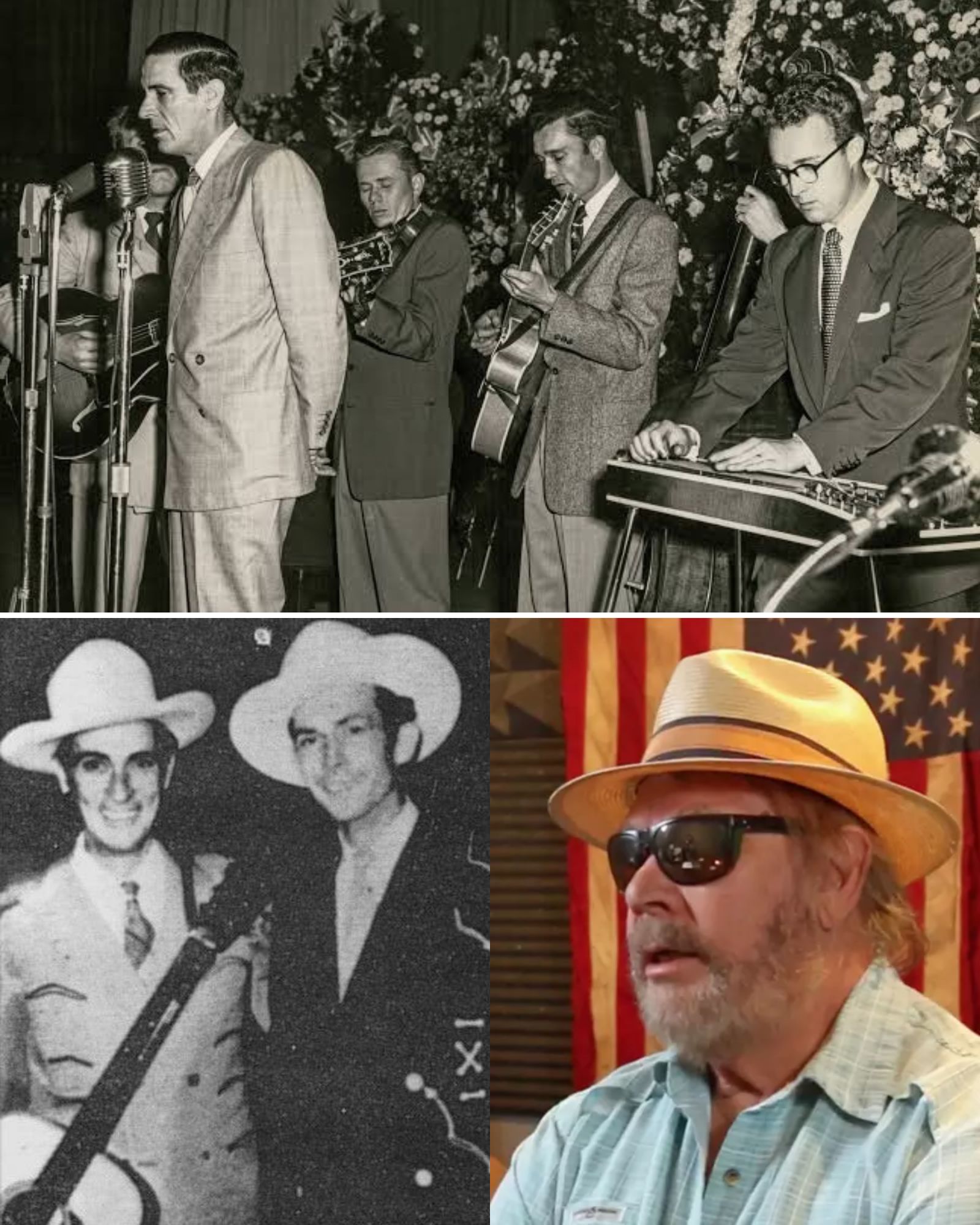
On the afternoon of January 4, 1953, the first song at Hank Williams’ funeral came from Ernest Tubb. Thirty years later, that same weathered voice turned up on a Top 10 country record by Hank Williams Jr., the boy who was only 3 years old when his father was buried. Two recordings hold the whole story, and both of them still exist.
The Song That Opened the Service
Hank Williams died on New Year’s Day 1953, at 29. Three days later, his funeral filled the Municipal Auditorium in Montgomery, Alabama, the same hall where he had performed. Montgomery’s fire chief and assistant police chief put the crowd at 15,000 to 20,000 people, and several thousand of them stood outside in the cold, listening as the service was carried over loudspeakers.
Ernest Tubb, Hank’s friend and one of the Nashville stars who had stood behind him, opened the service with “Beyond the Sunset.” Hank’s own band, the Drifting Cowboys, played behind the singers that day. Joe Azbell, city editor of the Montgomery Advertiser, wrote that the hall went completely silent as Tubb sang.
Then the service moved on. A Black gospel quartet, the Southwind Singers, sang a spiritual. Roy Acuff led “I Saw the Light.” Red Foley sang “Peace in the Valley,” and the Statesmen Quartet closed with “Precious Memories” before the benediction.
The hymn was already part of Hank’s own catalog. Hank Williams had recorded “Beyond the Sunset” himself in January 1950, as a recitation under his Luke the Drifter name. MGM released it as the flip side of another Luke the Drifter record, one called “The Funeral.”
The Tapes in the Hall of Fame
The Country Music Hall of Fame and Museum keeps a recording of the funeral in its digital collection, spread across four tapes. The listing for the first tape names the ministers who led the service and lists Ernest Tubb among the performers, along with the Southwind Singers, the Statesmen Quartet, Roy Acuff and other members of the Grand Ole Opry cast.
Seven Weeks Later, Back in the Studio
On February 24, 1953, Ernest Tubb walked into Castle Studio in Nashville and recorded two songs for Decca. One was “Beyond the Sunset.” The other was a tribute titled “Hank, It Will Never Be the Same Without You.” Decca put them out back to back on a single release that spring.
The Boy Who Was Three
Hank Williams Jr. was born on May 26, 1949, in Shreveport, Louisiana. By the early 1980s he was one of the biggest stars in country music, sometimes putting out two albums a year.
In February 1983, he released the album Strong Stuff. Its second single, released that May, was “Leave Them Boys Alone,” credited to Hank Williams Jr. with Waylon Jennings and Ernest Tubb. Hank Jr. wrote it with Dean Dillon, Gary Stewart and Tanya Tucker, and produced it with Jimmy Bowen.
The song talks back to the critics of the hard-living singers of the day. It defends Hank Jr. against the charge that he had wandered from his father’s music, and it ties the rowdy stars of the ’80s back to the honky-tonk men of the 1950s, Hank Williams and Ernest Tubb among them. Near the end, a voice on the record calls out to Ernest by name for one more pass at the chorus.
The single climbed to No. 6 on Billboard’s Hot Country Singles chart and No. 7 in Canada. It was Ernest Tubb’s last Top 10 hit. The same track also appeared on Waylon Jennings’ own album, Waylon and Company, that September.
One of the Last Times He Sang on a Record
By then, Ernest Tubb was a sick man. He had been living with emphysema for years, and he played his last show on November 13, 1982. “Leave Them Boys Alone” is often described as his final recording. One account dates his last session to 1982, so the exact order of his final studio days is not fully settled, but there is no doubt it was one of the very last.
“Beyond the Sunset” One More Time
Ernest Tubb died of emphysema at Baptist Hospital in Nashville on September 6, 1984. He was 70.
About 800 people came to his funeral at Two Rivers Baptist Church, near the Grand Ole Opry House. Hank Williams Jr. was one of the pallbearers. United Press International reported how he described the man he helped carry:
“A legend, a superstar.”
Hank Jr. added that there weren’t many left of the kind of artists Tubb represented, the kind he put in the same company as Johnny Cash and his own father.
Bill Monroe sang “Swing Low, Sweet Chariot” with no accompaniment, then looked down into the open casket and said goodbye to his old friend. The music at the service included “Precious Memories,” “Walking the Floor Over You,” and “Beyond the Sunset,” the hymn Ernest Tubb had sung for Hank Williams thirty-one years earlier.