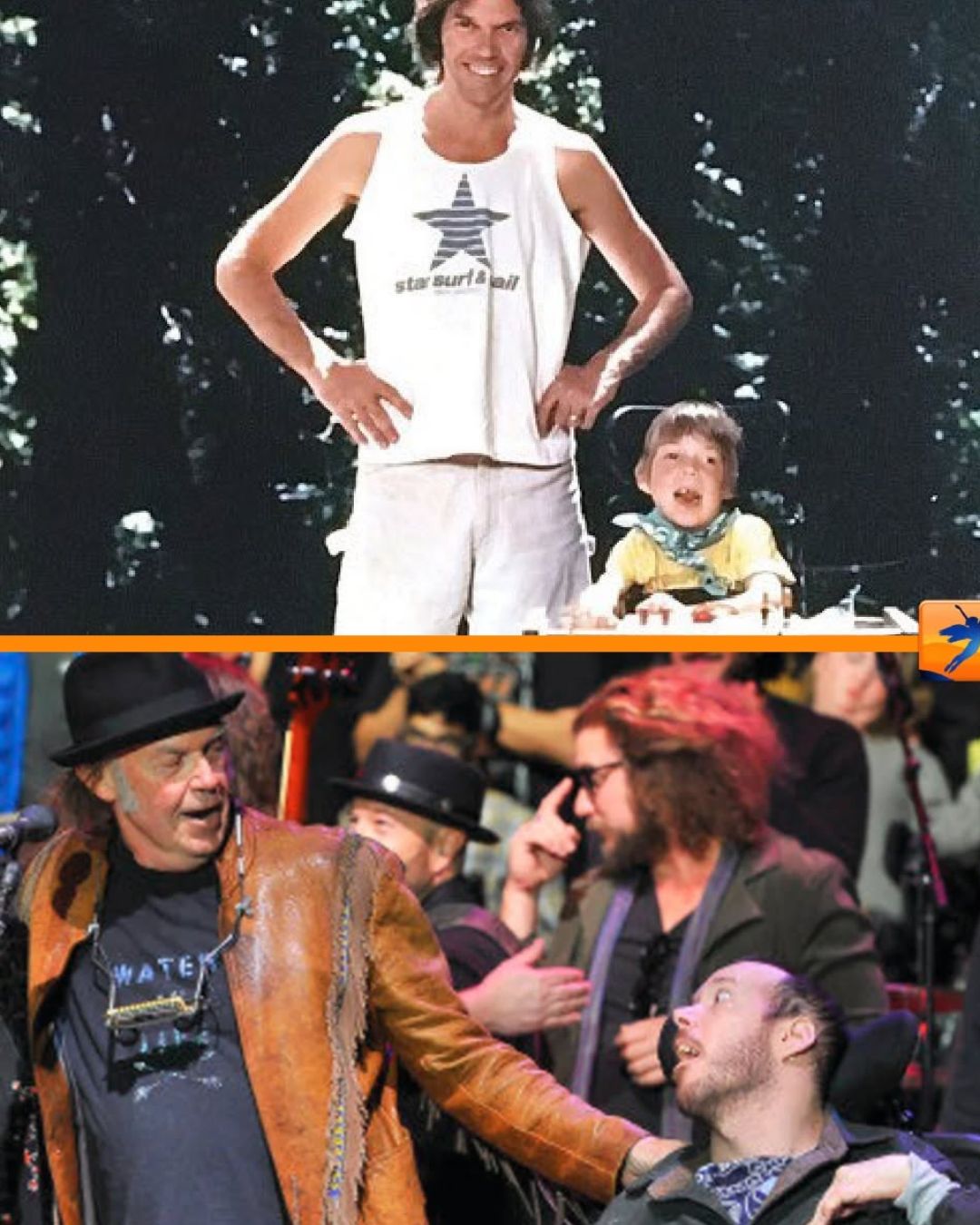
When Neil Young released Trans at the end of 1982, fans who had grown up on Harvest put the record on and heard a machine where his voice should have been. Many of the words were impossible to make out. For years, few listeners knew that this was the point. At home on his ranch in Northern California, Young was trying every day to understand his son Ben, who could not speak.
A diagnosis in the first months
Ben Young was born in November 1978, the first child of Neil and his wife, Pegi, who had married that August. Early in 1979, doctors told the couple that Ben had severe cerebral palsy. He was quadriplegic and non-oral, and they were warned there was little chance he would ever walk or talk.
It was not the first time the condition had touched the family. Neil’s older son, Zeke, born in 1972 to actress Carrie Snodgress, had a much milder form of cerebral palsy. Ben’s case was far more severe.
Ben slept poorly as a baby. Young later described long nights pacing the floor, patting his son’s back, and passing the hours by picturing the layout of a model railroad he hoped to build one day: long curves through hills, straight stretches of main line, rail yards. Years later, that plan went onto paper almost unchanged.
Fifteen to eighteen hours a day
From late 1980 to mid-1982, Neil and Pegi committed to an intensive home therapy program for Ben. In a 1995 interview with Nick Kent of MOJO, Young said it lasted 18 months and took between 15 and 18 hours of every day they had. Nothing else in their lives came close.
He kept making records through it, but he said the program consumed both Re-ac-tor, released with Crazy Horse in 1981, and the album that followed. At the time, he had not shared any of this publicly.
The machines in the studio
Trans began in late 1981 the way his records usually did, with Crazy Horse playing live in the studio. Then Young brought in two new machines: a Synclavier synthesizer and a vocoder, a device that turns the human voice into something flat and mechanical.
Crazy Horse guitarist Frank “Poncho” Sampedro later recalled that Young stripped the band’s playing off the tapes and replaced it with sequencers, synthesizers and his own processed voice. Young built the finished album from six of these electronic songs and three gentler tracks left over from a shelved project.
The album nobody understood
The reaction was confusion. Some critics admired the nerve, but many longtime fans felt abandoned. In 1983, Geffen Records, his new label, sued him for $3.3 million, claiming his music had become uncharacteristic of his earlier work. Young countersued, and the cases were later dropped.
Speaking to Rolling Stone in 1988, Young said the record came from
a part of my life that practically no one can relate to.
His music reflected his inner life, he explained, so it had become something almost nobody could connect with.
What he said in 1995
Young had hinted at the meaning for years. In the 1995 MOJO interview, he laid it out plainly. Ben, he said, was trying to find a way to talk and to reach other people, and that was what Trans was about. Listeners can tell he is singing something but cannot follow it:
you know I’m saying something but you can’t understand what it is.
That, he said, was exactly the feeling he got from his son.
“Transformer Man”
Young described the story behind the album as a hospital staffed by robot-like workers with electronic voices, whose one goal was to teach a little baby to push a button. The song at its heart, “Transformer Man,” was written for Ben.
A transformer is the box that sends power to a model train track. Young had loved Lionel trains since he was a boy in Ontario, and he wanted his son to run them too. But Ben had no fine control of his hands. He could not grip a throttle or press an accessory button.
A paddle, a whistle and a set of brakes
So Young built a way around Ben’s hands. In a 1993 feature, Classic Toy Trains magazine described the system he had created in a train barn on the ranch: a wireless paddle that Ben could lean his head into to start a train, and lean into again to stop it. Neil could switch the paddle’s function so Ben could blow the whistle or sound the horn whenever he chose. Father and son ran the railroad as a team, with Neil calling out the status from across the room.
The magazine recounted one afternoon when Neil stepped outside to deal with visitors. Ben stayed behind and kept the trains running on his own schedule, sounding the horn as he went.
Young also designed electronics that made the toy locomotives sound like real ones. He told SPIN in 1995 why the volume mattered:
When he causes something to happen, he can really hear it.
When Ben put on the brakes and heard them squeal, Young said, he knew he had made it happen.
What came after
That work grew into TrainMaster Command Control, the remote system Lionel sold from 1994, and in 1995 Young joined an investment group that bought the company. In 1986, Neil and Pegi also helped found the Bridge School in California for children with severe speech and physical disabilities.
Ben grew up and kept traveling with his father. Writing in 2020, Young noted that his son still rode on the tour bus with him. In 1982, almost no one could understand what Neil Young was singing. Within a decade, in a barn full of trains, his son was making himself heard.