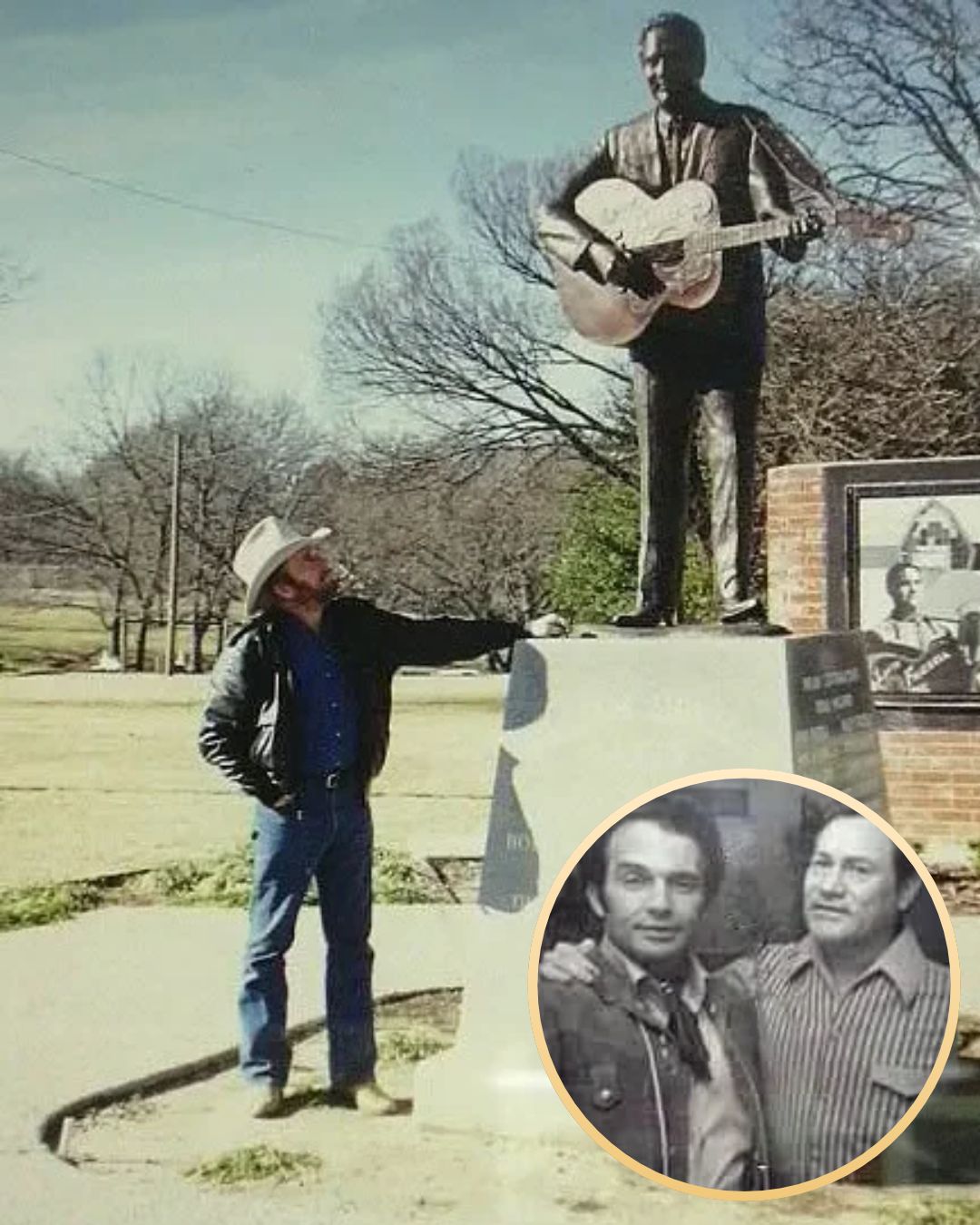
In 1953, Lefty Frizzell was the headliner at the Rainbow Gardens in Bakersfield, California, with a sold-out crowd waiting for him. He would not walk out until a skinny local teenager, just released from a reform school, had been allowed to sing first. That teenager was Merle Haggard, and he spent the rest of his life calling it the night everything started.
The boy who sang like Lefty
Merle grew up in Oildale, just north of Bakersfield, and taught himself guitar from the records in the house. He later wrote that for three or four years he sang almost nothing but Lefty Frizzell songs. He studied the way Lefty bent and stretched a word, and how easily Lefty owned a stage. Because Lefty loved Jimmie Rodgers, Merle learned Jimmie Rodgers too.
The first chance he missed
When Merle was 14, he and a friend bought tickets to see Lefty at the Rainbow Gardens. Before the show they drank so much beer that they passed out on the lawn outside and slept through the first set.
The next couple of years were rough ones, spent running away and in juvenile facilities. Merle was 16 when he came home from the reformatory in 1953, as Marc Eliot recounts in his biography The Hag. Soon his friend Bob Teague brought news that Lefty was coming back to the Rainbow Gardens.
This time Merle was not going to miss it. He planned his outfit for days and settled on khaki pants and a heavily starched white shirt borrowed from Teague, who drove them both to the club.
A knock on the dressing room door
The opening band that night was led by Billy Mize, a familiar name in the Bakersfield scene, and through him the two boys got backstage.
During intermission, before Lefty’s set, Teague knocked on the dressing room door and walked in as though he belonged to the band. He asked Lefty if he would like to meet a guy who sang just like him. Lefty said sure.
Lefty handed Merle his own guitar, a 1949 Gibson J-200 that guitar builder Paul Bigsby had fitted with a custom neck and a large pickguard bearing the name LEFTY FRIZZELL. Merle slipped the strap over his head and sang Lefty’s 1951 hit “Always Late With Your Kisses.” Lefty grinned and told him it sounded like his own record.
The promoter said no
Just as Merle finished, one of the show’s promoters, Joe Snead, came to tell Lefty it was time to start. Lefty had other plans.
“I want this kid to sing a song out there before I go on.”
Snead looked at him as if he had lost his mind. The crowd had paid to hear Lefty Frizzell, he said, not some local nobody. Lefty refused to go on unless the boy sang first. He won the argument, and Merle got to use Lefty’s guitar with Lefty’s band behind him.
In front of a thousand people
Merle walked out to a standing-room crowd of more than a thousand people who had come for the star. He sang Jimmie Rodgers’ “My Rough and Rowdy Ways” and Hank Williams’ “You Win Again.” The audience roared and stomped for more. Teague later said some people in the crowd honestly believed they were hearing Lefty.
Merle remembered it as a night when everything was against him and everything went his way anyway. When he came off, Lefty was waiting in the wings, laughing. He patted Merle on the back, told him he had done fine, and walked out to his own ovation.
Merle stayed in the wings for the rest of the show, watching how Lefty held the room. He said later that he knew right then this was probably what he was going to do.
The guitarist’s last night
One more meeting happened on that stage. Before he sang, Merle introduced himself to Lefty’s lead guitarist, Roy Nichols, whose string-bending he knew from Maddox Brothers and Rose records. Nichols, in a sour mood, told him the job was not worth much and that this was his last night with Lefty.
Years later, when Merle put together his own band, the Strangers, Nichols was the first musician he hired. He stayed for more than two decades.
The long road after
The night did not make Merle a star. Trouble followed him for years, and by early 1958 he was in San Quentin. He was paroled in 1960 and began building his career in the clubs around Bakersfield.
He never stopped giving Lefty the credit. In one interview he said Lefty was ninety percent of the reason he was in the business at all. Lefty Frizzell died of a stroke on July 19, 1975, at 47. In February 1984, Merle took “That’s the Way Love Goes,” a song Lefty co-wrote with Sanger D. Shafer, to No. 1.
In 2001, Merle recorded Roots, Volume 1, built largely around Lefty’s songs and cut with Norman Stephens, who had played guitar on Lefty’s early records. One of the songs on it was “Always Late With Your Kisses,” the same one he had sung in Lefty’s dressing room almost 50 years earlier.
The guitar comes home
Lefty’s Bigsby J-200 had its own journey. For many years it was on loan to the Country Music Hall of Fame and Museum in Nashville. In January 2005 it was returned to the Frizzell family, and it was later offered for sale by Retrofret, a vintage guitar shop in Brooklyn, with a reported asking price of $350,000.
The buyer was Merle Haggard. In a 2003 interview, he had described what that instrument meant to him.
“That is the first guitar I played on a professional stage.”
In 1953, Lefty Frizzell would not play a note until the kid from Oildale had his turn with that guitar. More than half a century later, the kid brought it home for good.