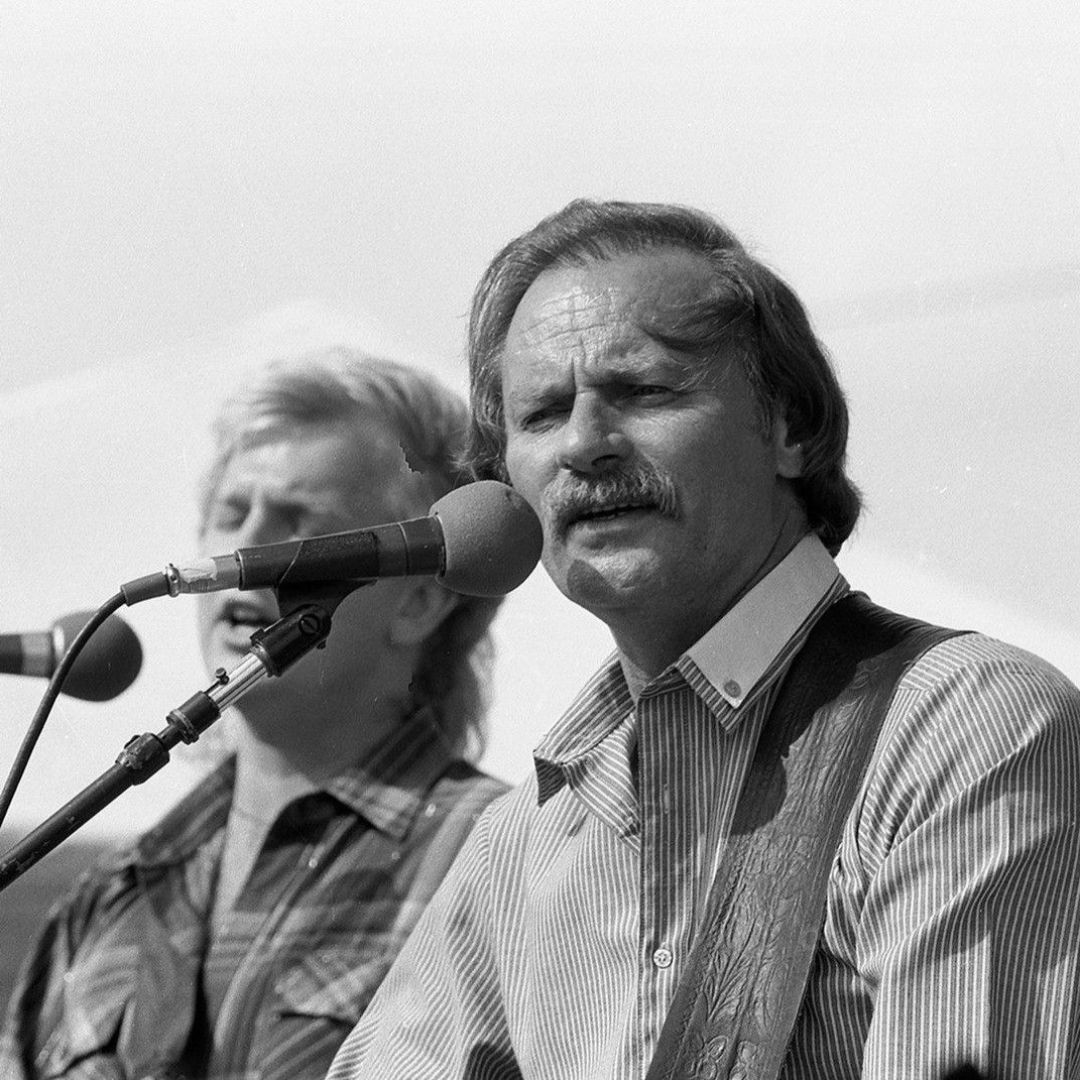
When Vern Gosdin’s marriage fell apart in late 1988, the country singer was left with a broken relationship, a house that no longer felt the same, and one unexpected companion: a Labrador retriever named Smoke.
That detail came straight from Vern Gosdin during an October 1989 interview with journalist Dave Hoekstra. A story had been circulating that the singer’s wife of 11 years had walked away around Christmas, leaving behind only a coonhound.
Vern Gosdin corrected the reporter. Smoke wasn’t a coonhound. Smoke was a Labrador, a dog Vern Gosdin treasured and wouldn’t have traded for anything.
Behind that almost humorous correction was a painful chapter in the life of a man country fans had come to know as “The Voice.” And the songs that followed would become some of Vern Gosdin’s most personal recordings.
A Marriage That Became the Story Behind Alone
By the late 1980s, Vern Gosdin had already spent decades in country music. The 1988 album Chiseled in Stone had brought renewed attention to a singer whose traditional sound stood apart from much of the music industry.
But success on the country charts did little to soften what was happening in Vern Gosdin’s private life.
In a separate interview published in 1990, Vern Gosdin recalled returning from the road and contacting his wife, who was visiting her mother in Atlanta. The marriage was ending, and the experience soon became material for songwriting.
During the October 1989 interview, Vern Gosdin made clear that the divorce wasn’t something easily dismissed.
“It really hurt.”
Vern Gosdin explained that the sadness had put him in a position to write. There was no carefully planned concept to manufacture heartbreak for an album. The songs grew from circumstances Vern Gosdin was actually living through.
On June 27, 1989, Columbia Records released Alone, a ten-song collection produced by Bob Montgomery.
The Songs That Told Different Parts of the Breakup
What makes Alone especially interesting is how directly Vern Gosdin connected individual songs to the experience of separation.
In an album interview with radio personality Biff Collie, preserved by the Country Music Hall of Fame, Vern Gosdin discussed the stories behind several recordings.
Vern Gosdin described That Just About Does It, written with Max D. Barnes, as a song about a breakup Vern Gosdin had seen approaching. The recording reached No. 4 on Billboard’s country chart.
Another song, I’m Still Crazy, reflected the experience of coming home to an empty house. Written by Vern Gosdin, Steve Gosdin, and Buddy Cannon, it became the album’s biggest commercial success.
On September 2, 1989, I’m Still Crazy reached No. 1 on Billboard’s country singles chart, becoming Vern Gosdin’s third and final chart-topper.
Vern Gosdin also connected Right in the Wrong Direction to the failed marriage. And when discussing You’re Not by Yourself, the singer again referred to feelings surrounding his wife’s departure.
These weren’t simply ten interchangeable songs about lost love. Several recordings reflected different experiences within the same difficult period.
The Unexpected Story Behind Another Song
Not every recording on Alone came from the divorce.
During the same October 1989 interview, Vern Gosdin recalled writing Tanqueray with three other songwriters in a bar in Amarillo, Texas.
Steel guitarist Jim Vest had an empty bottle of Tanqueray, and the writers were looking for a subject. The bottle provided the idea.
That lighter songwriting story offers an interesting contrast to the record’s prevailing mood. Vern Gosdin wasn’t writing exclusively about heartbreak, even during a painful period.
Vern Gosdin also described carrying a small notebook to capture ideas whenever an interesting remark caught his attention. At the time, the notebook contained roughly 150 possible ideas.
For Vern Gosdin, songwriting remained an everyday habit, whether the inspiration came from a conversation, a barroom observation, or a marriage ending.
What Vern Gosdin Still Couldn’t Forget
By the time Vern Gosdin spoke with Dave Hoekstra in October 1989, Alone had already produced a No. 1 country single.
The music was reaching listeners, but the breakup remained deeply personal.
Vern Gosdin acknowledged that even after the separation, the feelings for his wife had not simply disappeared. That admission helps explain why the songs on Alone still resonate with listeners who have experienced the end of a long relationship.
There was no need for Vern Gosdin to invent an elaborate story. An empty home, an eleven-year marriage, a faithful Labrador named Smoke, and the memories of a relationship were already enough.
More than three decades later, Alone remains a revealing record of that period in Vern Gosdin’s life. Its strongest moments are closely connected to events the singer discussed openly in contemporary interviews.
And perhaps the most memorable detail isn’t a chart position or an award. It’s that when Vern Gosdin looked back on everything that had happened, the singer still remembered exactly what had been left behind: a Labrador named Smoke.