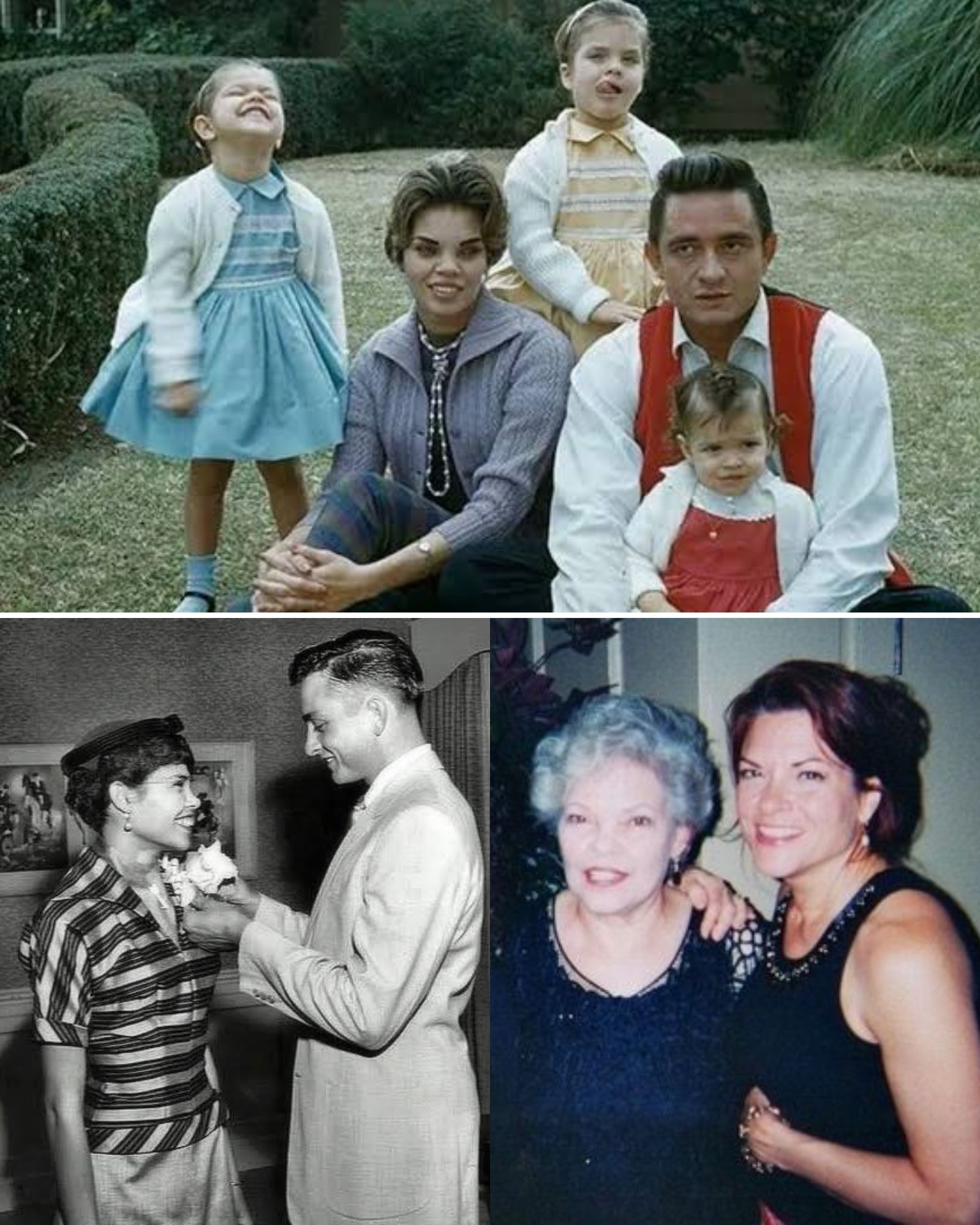
On November 10, 2003, two months after Johnny Cash died, his first wife, Vivian, walked into Nashville’s Ryman Auditorium for a televised memorial tribute to the man she had married in 1954. She came with all four of their daughters, Rosanne, Kathy, Cindy and Tara, and their husbands, and they took their seats together in the old wooden pews.
Vivian had sat in those same pews 47 years earlier, on July 7, 1956, the night Johnny walked onto the Grand Ole Opry stage for the very first time.
The Night It Started
Johnny Cash was 24 that summer, a Sun Records artist living in Memphis with Vivian and their young family. “I Walk the Line” had come out in May and was climbing the charts. Johnny had described it as a pledge of devotion he wrote while newly married, and it was on its way to becoming his first No. 1 country hit.
On the Opry that Saturday night, Carl Smith introduced him, and Johnny and the Tennessee Two played three songs: “I Walk the Line,” “Get Rhythm” and “So Doggone Lonesome.” In her memoir, Vivian recalled how much it meant for him to share a bill with names like Minnie Pearl and Grandpa Jones. Her book places that night two months before “I Walk the Line” was released, but Sun had issued the single that May, so her memory of the timing is a little off. The night itself is well documented.
Backstage that same evening, Johnny met June Carter for the first time. She was married to Carl Smith, and he was married to Vivian. Ten years later, in 1966, Johnny and Vivian divorced, and in 1968 he married June.
“Something Like an Unwelcome Guest”
Vivian Cash opened her memoir, I Walked the Line: My Life with Johnny, with the weeks around Johnny’s death and that November night at the Ryman. She had visited him at his home in Hendersonville only about eight weeks before he died, a visit she later called a precious gift.
Going back to the Ryman was harder. She described the building as the inner sanctum of the Nashville establishment, and she wrote plainly about how it felt to arrive:
“I felt something like an unwelcome guest.”
She admitted she might have stayed home if her daughters hadn’t insisted she come with them. A public look back at Johnny’s life, she explained, meant a public look back at hers too.
Outside, the scene was quiet. Vivian wrote that fans had gathered in front of the building holding candles, and that one man stood alone playing “Folsom Prison Blues” on a banjo.
Rosanne Takes the Stage
More than 2,000 people filled the Ryman that night, many of them fans who had won free tickets in a lottery. Tim Robbins served as host, and the lineup ran from Willie Nelson, Kris Kristofferson and George Jones to Sheryl Crow, Kid Rock and John Mellencamp.
Early in the evening, Rosanne Cash, the oldest of Johnny and Vivian’s four daughters, stood beneath a large image of her father and sang his “I Still Miss Someone.” The Washington Times noted that she was accompanied only by a Fender Telecaster and an upright bass. A review in No Depression described her version as slow and true, carrying so much loss that it seemed to say what everyone in the room was feeling.
What the Crowd Cheered, and What She Remembered
Sitting in those pews, Vivian was struck by something else. She watched hundreds of people celebrate Johnny’s darker side with laughter and admiring comments: the famous photograph of him making an obscene gesture, the night he kicked out the Opry’s footlights.
That was not the Johnny she carried with her. In the same pages, she listed the things she remembered instead: their little girls giggling as he played with them on Christmas morning, the smell of Johnny making biscuits in their kitchen from a recipe only he knew, fishing with him, and the two of them dyeing his hair black in the kitchen sink.
The Dedication Television Didn’t Show
One moment from that night was meant directly for Vivian. Rodney Crowell, Rosanne’s former husband and the father of three of her daughters, dedicated his performance to her from the stage.
When CMT aired The Johnny Cash Memorial Tribute: A Celebration of Friends and Family that weekend, the dedication was not in it. The moment resurfaced years later in My Darling Vivian, a 2020 documentary about her life built around interviews with all four daughters. Director Matt Riddlehoover told InsideHook that Crowell mentioned the missing dedication to him, so he went through the unedited footage CMT had sent the family. The dedication was there.
The Last Word
Vivian Liberto Distin died on May 24, 2005, at 71. Her memoir came out two years later, in 2007. It begins with Johnny’s death and that night at the Ryman, and its title borrows the song he sang from that stage in 1956, changed by one word: I Walked the Line.